
Observe the Structure, Wait for the Signal
The business of speculation is entirely unique. What’s required to succeed in this business often runs counter to what’s required to succeed in other lines of business. Virtually all other businesses involve some element of salesmanship. Sales is denoted by its busyness. In sales, being busy, or even just the appearance of being busy, confers to others that you are working.
Not so with speculation. The work of speculation is denoted by its lack of busyness. This apparent lack of activity is easy to mistake for idleness; even after years of trying to explain what I do for a living to my wife, she still can’t believe that work is anything other than continuous motion and constant action.
I can’t blame her for thinking my lack of appearing busy is idleness, but what I’m actually doing is anything but idle. I spend on average 25 to 30 hours a week doing real work, and about 5 to 10 doing admin and maintenance. Of the 30, at least 15 hours is spent in observation. To her, my work in observation looks like doing nothing, but it’s the most critical activity for my work. I’m observing the market and waiting for something to appear that looks familiar to me. I’m searching for the one setup I know works for me.
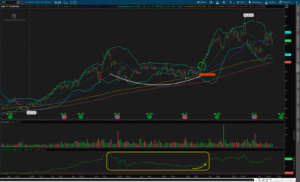
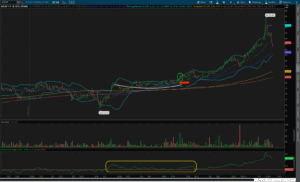
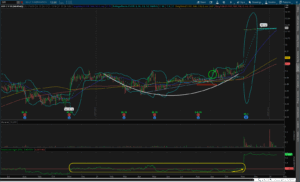
There’s really only one technical setup that I can attribute to all my winning trades: a long base and a breakout within a strong general market. Here’s my best winning trades from 2025. They all share the setup I like with a base in white, a breakout in green, elevated RSI in yellow, and most importantly, a stop in red:
$AGI:
$ATUSF:
$GIFI:
$DAC:
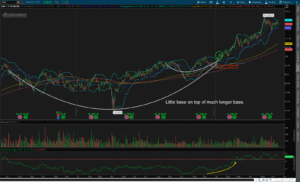
$MT:
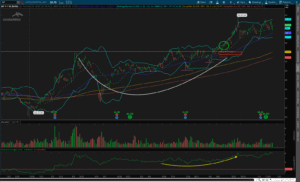
Each of these trades had two things going for it: 1) a technical setup that I recognize combined with the SPX above it’s 8 and 21 day moving averages, and 2) a fundamental theme or compelling valuation.
The technical setup writes its own story: there is a negotiation between buyers and sellers inside the white base that forms a price structure with a flat top. All throughout this price structure formation, I’m observing. I’m waiting to see a signal.
The breakout in green is the exact moment in time that the buyers have bought up all the available supply of stock. In order for the auction to occur, the price must work higher. The best stocks will show strength for some period of time before the breakout. The very best trades have a logical stop that is not more than 7% below the breakout level.
The closer the logical stop is to the breakout, the less risk there is and the larger the position can be. I use a constant risk position sizing so any trade will never risk more than 1% of my account, and each stock should be under 10% of the account in case of a gap down beneath the stop.
I’ll relax this requirement if I have a compelling fundamental reason for feeling OK with a large single stock position.
The fundamental part of owning a stock is a lot more difficult to pin down than the technical. Each stock from my 2025 trades had a fundamental appeal to institutional investors that made it compelling to own.
$AGI’s cash flows were surging with the price of gold, and it was trading at the same cash flow multiple as the average stock when it should have been trading at a premium due to the cash flow ramp.
$ATUSF was very cheap at 7x cash flow when it broke out at $20. This is far too cheap for a company with as high a caliber management as Altius.
$GIFI, Gulf Island Fab, was right in the sweet spot – oil and gas ancillary services was the right theme, they had no debt, and growing backlog and earnings for several quarters. It was all right there in their SEC filings. I had no idea they would get a buy out so quickly after the breakout signal.
$DAC broke above $100 right at the beginning of 2026. It was trading at less than book value at the time, and earnings were stable. I figured it shouldn’t trade at a discount to book. I had no idea the shipping disruption that was about to come with the Strait of Hormuz, but institutional buyers did. They bought up all the supply under $100.
$MT was in the metals and mining theme that was working so well in 3Q and 4Q 2025. I didn’t know it at the time the stock broke $35, but the EU was ramping up steel tariffs in a big way. ArcelorMittal was trading at 70% of book value before the EU tariff announcement while US companies like $NUE and $STLD were already rallying and trading much higher than book value. $MT was an easy target for institutional sponsorship.
The reason I was able to participate in these moves is because I was observing. I know what I want to see, and I keep on the look out for it. I won’t always get every move, and it’s painful when I see a technical setup I recognize but can’t get a fundamental understanding of the valuation component. Because a lot of the story-stocks in this market are pretty un-analyzable from a fundamental perspective, I have to sit on the sidelines for a lot of the big moves that these stocks achieve. Stocks like $TSLA, $ASTS, or $RIOT can have great setups, but if I can’t get an understanding of why they may be compelling from a valuation perspective, I’ll have to pass.
Some stocks which are more suited to my analytical abilities that I’m observing right now are: $BIIB, $MRK, and $NVS.
The technical setup is easy to see: a base with a flat top forming and strong RSI. I’ll be observing those stocks as the price structure develops and waiting for a breakout that occurs with the SPX above it’s 8 and 21 day moving averages.
I think we’re in the contraction phase of the business cycle so the defensive sector stocks like the medicine stocks should start to get more attention from institutions if my view is correct. If my view is wrong, and we’re only in the slowdown phase of the cycle, there could be more inflation and economic ups and downs before the contraction phase.
For that scenario, I’m observing $RIG, $NBR, and $PDS. Again, all nice price structures that fit into the only pattern I want to look for. Whichever scenario comes to fruition, I’ve got stocks on my watchlist that I’m observing and for which I’m waiting to receive a signal.
The market doesn’t have to cooperate with me. I may spend hours and days in observation, and these stocks don’t give a good signal, or give a false signal and flop back in after a fake breakout. That’s why stops are crucial to any speculative endeavor. When I’m observing, that’s what I’m thinking about: where price is forming a logical support level that won’t be breached if the breakout is real and institutions want the stock.
All the work of observation I do may not look like activity, but it’s necessary in order to align my positions with big institutional money. When institutional money accumulates stock, they leave evidence. It’s only deliberate observation that reveals this evidence. That is the work of a speculator.
By: Patrick G. Full-time independent trader in Atlanta, GA.
Patrick G is a full-time trader. Worked for a decade in a money management firm as a trader for high net-worth individuals.
He invested his and his family’s net worth into gold and mining stocks before the Covid money printing. Gold and commodity runs of the past 3 years allowed Patrick to trade full-time due to his gains.
Past performance does not guarantee future results. Trading involves significant risk of loss, and individual results vary. Positions mentioned are the author’s own, disclosed for transparency — not individual investment advice.

5 Days Free in a $7,000 Trading Room
Trade alongside David Prince live, Oct 26–30