
Brace for Impact
I’ve been trying to catch the bottom in TLT and the top in rates since March. Thrice I’ve thought I’ve seen a bottom, bought, and have gotten stopped out for a loss with the third attempt occurring this week at $77 on the TLT. Rates should have spiked out in the last Fed meeting and be sinking back towards 3.75% by now, and the market should be breathing a sigh of relief. Instead, rates on the 10yr remain “bid”, and the 2-10 yield curve is re-steepening. This is a pretty wicked bear steepener at a moment when we should be seeing a bull steepener where the short end falls as the business cycle enters into the contraction phase. The facts that Warsh raised at the last meeting and that there is talk of another hike this month are alarming. I’m not saying the Fed is doing anything wrong, as I think they really just follow the bond market where it wants to take rates rather than set rates themselves (which is the way it should be in a free market system), but the fact that they keep seeing a need to hike means that the natural path for rates is higher even at these elevated levels. The dollar agrees with rates as its uptrend remains firm. Every penny above $101 on the DXY is pulling demand from financial assets like stocks and broadcasting the slowing velocity of dollars in the real economy.
While the real economy is not in as terrible of shape as people feel, the financial economy is in a far more dire situation than prices would suggest. Stocks are far too expensive for any real capital allocators to step up and bid even if we get a 20% correction. I think the odds of an October crash are increasing with every tick higher in the 10yr yield. In real life, it’s irresponsible to yell “fire” in a crowded theater, but when my irreplaceable capital is on the line, my policy is to panic first and ask questions later. I can always chase stocks higher if I need to. There will be wave after wave of sectors and stocks in those sectors that setup and breakout if this spurt higher in the S&P and the NDX has legs and the market gets away from me while I’m in 75% cash. I’m wondering now if even that much cash is too little…
Policy makers have staved off a normal correction at every turn since 2012. Capital allocators have never forgotten, and prices seem to have a memory as well; the SPX tagged its 2014 highs in the March 2020 spike down as a form of declaration that the move from those levels has significance. Like water in a container after a perturbance, stock prices will want to level out at a natural equilibrium, but we have no idea where that is after a decade of central planning. I’ve been waiting for a rally back to $53,000 in the DJI for a chance to short, but now I’m wondering if I’ll get that chance at all.
The way I thought this story of a market top would play out is a nice looking, although unhealthy breakout in the SPX and NDX and a bounce in the DJI and RUT near their 200 day moving averages; all being the result of a normal bounce in the US Treasury bond long end as rates peaked then sank lower. There still may be a chance it plays out that way, but the TLT would have to bounce hard in the up coming week. We’d want to see the bonds rally as SPX falls as that would indicate a normal end of a cycle and maybe a 20-30% drop in stocks (which wouldn’t alleviate the expensiveness of stocks, but prices of all things may never get back to pre 2020 levels). I was expecting that level of correction to happen pretty quickly in October which would give it a “crash” feeling. But if rates keep going higher, and assuming I’m correct in my view that stocks reset lower this month, it means we have something else on our hands entirely.
There are exactly zero market participants that have a working memory of trading through a market when both stocks and bond are declining. That’s the scenario we could have in front of us if the TLT doesn’t start reversing hard this week. The last time stocks and bonds declined in unison was in the 1970’s, and to viscerally remember the experience of trading through that, a trader would have had to have been in his 30’s then, which would make him in his late 80’s now. We don’t have any 86 year old traders now that Buffett is retired. The only source of knowledge we have on that period in market history has to come from books. Buffett’s annual letters are the only source I’ve read on the topic, and it doesn’t sound like an environment in which traders conditioned to a decade of central bank intervention could thrive.
We are all products of the environment in which we grow, and while it is possible for a skilled trader to adapt to a new market environment, the unfortunate reality is that a bull market makes many traders more successful but undisciplined. I’ve known traders that came of age in the bull market in the late 90’s and got rich. They were professional traders that made it through the .com burst and kept winning into the 2008 burst, but they struggled to adapt to the QE era starting in 2012. Some of those guys were amazing traders, pushed through their obstacles and are still winning consistently in the market today. One saw even more success in 2021 than he ever had in decades of successful trading and retired from full time trading with a massive account in the 8 figures. These guys are proof that we can adapt and thrive in any market environment. However, there are also horror stories of guys with Etrade accounts in the 90’s bull market that thought they were great, but ended up back in a cubicle when the bubble popped.
The image of a once proud and successful trader who was once in charge of his own destiny, now resigned to dependence on a corporation for income, pacing in the back parking lot of an industrial distribution center converted into a telephone sales call center on his cigarette break, brushing off my youthfully ignorant questions about how to win in the stock market with a polite gruff in his thick Boston accented voice pushed through a gravelly larynx from years of stress suppression through smoking is seared into my memory as a warning of what terrible fate awaits those who don’t protect capital and adapt to what the market brings.
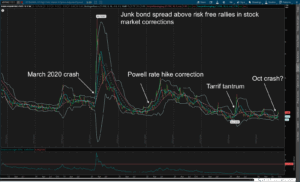
As for me, I’m determined to never go back to the cubicle. I will keep my capital intact no matter the cost. Right now, that cost is missing out on a news driven rally. That news may be a cessation of hostilities in Iran, or an improvement with trade relations with China, or anything else that is a concern at the moment. Until this month of October, famous for crashes in 1929 and 1987 that look awfully similar to the setup we have in 2026, passes, I’ll remain extremely cautious. That means keeping tons of cash, tight stops on any trades I do take on the long side, and a willingness to abandon my caution should the underlying health of the market improve. I’m watching new 52 highs and new 52 weeks lows every day. If the new highs starts to expand to around 375 on the NASDAQ, I’ll start to relinquish my bearishness. New lows have been expanding this entire rally since mid September, and I’d want to see them start to collapse to feel bullish. The expansion out of a volatility squeeze in junk bond spreads also has me concerned. If the Bank of America/ Merrill Lynch High Yield Option-Adjusted Spread were a stock, I’d be buying it hand over fist. Option spreads on junk bonds blowing out to the upside are always the first warning of stress in the financial markets. This is a signal that now is not the time to be playing aggressively on the long side.
BAML Option-Adusted Spread:
The time will come when it will pay to be aggressively long something. I think gold will have that potential only when price gets down to $3,825. I’ll start buying there, and I’ll get more size on down at $3,120, a level that if reached, would be, by my analysis, the lowest gold price for the rest of human history. That is the only “sure bet” (meaning high probability) I can see at the moment, and sure bets are the only kind I want to take in size in a market fraught with risk like this one. Gold is in a weak price structure so I’m putting high odds on being able to buy it down near $3,825.
I’m also keeping my eye on other hard assets for a long term buy. Most metals and mining stocks are no longer cheap after the rally in the sector started a year ago, but timberland is still cheap. Back in the last commodity run up in the mid 2000’s, timberland was all the rage with private capital. They bought up vast acreage of timberland and bid up the price to where it couldn’t earn decent returns on capital. There they have sat in a low return asset for almost two decades as housing starts remained in recessionary levels. Now I think they are finally dumping at the bottom, and the timber stocks are starting to be released from the weak hands.
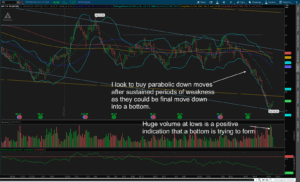
Weyerhaeuser, symbol WY, has undergone a parabolic down move recently and the massive volume this week on the lows has got my antenna up. It looks like a puke out low, but there’s been alarming amounts of insider distribution this year. Directors and the C-suite were selling tons of shares near $25 in the first quarter of the year. We can all see the price decline, but we don’t yet know the reason they were selling. WY reports at the end of the month, and I’ll bet that’s when we get a definitive answer as to whether the insider selling was justified or not. There’s either going to be a big guide down and write off with a massive revaluation lower on the shares towards 2020 lows or a mundane bad news report on housing demand for lumber. If the stock shrugs off that report without gapping down, it will be a big tell that this was indeed the bottom. Since timberland has been in a secular bear market for almost 2 decades, this stock has potential to be a great long term asset as it is at a secular low. There are signs in the timber industry that stumpage prices are entering an inflection point as no replanting has occurred in years which slowly takes out supply. There has also been activity in the industry lately that consolidates timberland into bigger entities.
WY:
WY’s nearest competitor, Rayonier, symbol RYN, recently merged with PotlatchDeltic, which itself was a merger between Potlatch and Deltic Timber some years earlier. The small timber REITs needed to merge to survive the persistent depressionary conditions in the housing market. After the 2008 housing crash, home building never recovered to the levels it saw in the boom. Demand for timber waned. This was especially problematic in the Southern US region where WY and RYN own vast acreage of timberland. The south is home to Southern Yellow Pine (SYP) timber which is cheaper than its cousin in the Pacific Northwest, Spruce Fur Pine (SFP). The Pacific Northwest timberland is regulated by the USDA who limits harvesting, so there is always less supply of SFP timber. Western pine beetle infestations also reek havoc on SFP timber groves. Western timber is highly sought after for framing houses so the low supply and high demand result in a high price. The south is all private land so there are no restrictions, thus supply is greater and prices are lower. SYP also has a tendency to be more warped than SFP so it can’t command as high a price as the Western timber. These regulatory and biological factors contribute to less valuable acreage in the Southern region where WY owns most of its timberland. The result has been a stock price that has gone nowhere in the biggest stock bull market of all time.
That could be about to change. Housing prices are unaffordable because this country hasn’t been building enough entry level housing in two decades. The 21st Century ROAD to Housing Act was passed in July, and it could be the jumpstart the housing industry needs to get out of the doldrums. The rest is now up to local zoning boards of municipalities to encourage more affordable home building at the expense of the higher tax revenue they would have received based on the value of a more expensive home. If the big municipalities don’t want to play ball, some small municipalities adjacent to those will use this opportunity to encourage small, modular homes to be built within their borders and entice young families to move there. Demand for housing lumber has the largest impact on the value of timberland stocks like WY.
WY reports on Oct 29th, and I’ll be watching like a hawk for signs that housing is at an inflection point. Timberland is just the kind of asset I’d like to own in an environment of monetary debasement that we are sure to enter into after the next stock market downturn. That downturn could arrive this month in the form of a violent stock market crash. The best course of action is to protect capital and brace for impact.
Lastly, a word of caution: please do your own research before placing a dime of your hard earned money into this market. Everything I write can only be considered as data for your own analysis. Nothing you have read here is investment advice, which is personal to your own circumstances that you should discuss with a trusted advisor. I am a speculator, and I take risks with my own capital that I would NEVER suggest others to take.
_________________________________________
By: Patrick G. Full-time independent trader in Atlanta, GA.
Patrick G is a full-time trader. Worked for a decade in a money management firm as a trader for high net-worth individuals.
He invested his and his family’s net worth into gold and mining stocks before the Covid money printing. Gold and commodity runs of the past 3 years allowed Patrick to trade full-time due to his gains.
Past performance does not guarantee future results. Trading involves significant risk of loss, and individual results vary. Positions mentioned are the author’s own, disclosed for transparency — not individual investment advice.

EVENT: 3 Strategies Working Right Now
David Prince shows you EXACTLY how to find big wins:
*By opting in, you consent to receive content and promotional emails from T3 Live.