
Assume the Crash Position
There’s an old Wall St. legend that Joseph Kennedy Sr. kept the family fortune that he amassed from bootlegging by getting out of stocks just before the 1929 crash. His opportune timing was the result of his astute observation that even his shoe shine boy was giving him stock tips. Kennedy reasoned that if even the most uninformed shoe shine boy was levering up in stocks, there was literally no one left to buy stocks.
I was reminded of that legend last week standing in line at the bank. There was an octogenarian at the only open teller, and I was next in line. While patience is the only virtue I possess naturally, and abundantly so, even my heroic levels of patience wore thin as I waited for this elderly gentlemen to figure out how to use the card reader to allow the teller to access his account. He was completely oblivious to the line forming behind him as he recounted his stories from opening up his first bank account in the 1970’s while the teller came out from behind the booth to operate the card reader for the old man. His stories went on, and he divulged many details about his financial life as the line grew longer behind me. He was there to transfer money from his RMD, the required minimum distribution, from his IRA. He was heavily in stocks and quite excited about all his gains that allowed him to now consume in his retirement. He struck me as someone whose enthusiasm for the stock market was far greater than his aptitude in operating in the stock market.
This was my shoe shine boy moment. I saw embodied in this old man the spirit of a hapless shoeshine boy whose entire fortune is resting on hopes of a greater fool to come along and buy his stock from him at a higher price. This was the moment my bearish inclination hardened into a firm resolve to short this market.
The market breadth has been bothering me for some time, and I’ve been in about 75% cash for a while, but this short setup is too perfect to pass up so I’m reflecting my increased bearishness by shorting. I’ve been laying out my bearish case for over a month. Nothing I’ve seen has changed my mind, and it remains this: I think the 2026 market looks awfully similar to the 1987 and 1929 stock market crashes. We saw a summer rally, a break in late August, and now we are in the rally back up to the break level. All that remains is a failure to recapture the breakdown level, and then an October crash would complete the template.
The signal I’ve been waiting for occurred Wednesday this week. The signal I wanted was a follow through day to the down side after a failure at the breakdown level. Tuesday, the Dow Jones Industrial Average got rejected at the $53K level on bank earnings. Wednesday is what I’m considering the follow through day. I’ve got a low risk stop right above the 50 day moving average which is 2% higher. A good crash could see a 20% down move so this risk to reward setup is too good to pass up. Here’s a pro tip, if you ever get a 10:1 odds payout, you take that trade every single time. I win on only 60% of my trades, so there’s a 40% chance I get stopped out of this trade at a loss. I’ve accepted the terms of the trade, and I’ll live with the consequences. This is a trade I like because I think I’ve got an edge here. That edge is my knowledge of historical precedent for a crash.
I like to read old newspapers from the 1929 era to get a feel for the zeitgeist. Recently I’ve been reading the Financial Chronicle. One thing that stands out is how commonly accepted was the inevitability of a crash due to all the speculative excess that was occurring for two years leading up to the top. Back then, as will be this time, blame was placed on the Fed’s easy money policies. Back then, it was understood that the Fed’s credit creation was leading to all manner of unprofitable business venture that served no purpose (read the Oct 26, 1929 edition of the Financial Chronicle). Today we have crypto currencies, and there is untold amounts of time, talent, and treasure poured into this enterprise of dubious value. Nothing has changed in a century since the last big crash or since the South Sea collapse three centuries ago. Human nature remains the same today as it has been throughout all human history. We tend to over estimate the benefits of the future and look for ways to get rich quickly. This is what allows bubbles to form. Like all bubbles, this one too must eventually pop, and my view is that this one’s time has come.
Of course the pundits will blame speculators when this bubble pops. But of course it’s not us speculators that cause the bubble. It’s policy makers that create the incentives for bubbles to inflate. This time around, with the Internet, there will be a permanent record (until it eventually gets scrubbed) of all the warnings since 2012 made by market participants that policy makers were setting us up for some terrible bubble to form that would eventually succumb to market forces and pop.
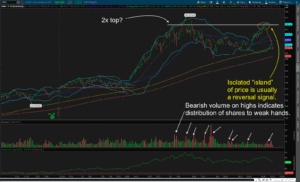
The pin that pops this bubble could be a foreign central bank move. Either the Bank of Japan or the People’s Bank of China are likely culprits. The pin could also be an Anthropic IPO. This would suck up massive amounts of speculative capital and unleash tons of new shares into the market. The AI trade in general looks vulnerable with a topping pattern in the SMH. It looks like a double top to me. The last top at $630 also has an island with three days of isolated price. That’s always a bearish sign. Those are trapped longs that are now hoping for higher prices to get out. If this is the top in the SMH, it will put to rest the AI story, and this cycle will most certainly be over. That island of price in SMH is a big warning sign to me, and I’m trying to relay the warning to all the semiconductor bulls I can. So far my expression of concern is met with shrugs. No one I talk to seems to take the price warning seriously, and their apathy towards the SMH bearish price signal has me doubting whether I’m reading the situation properly. Everyone else is pointing to AI demand for chips, and I’m pointing to the price structure on the chart. Here it is below. The reader can judge for themselves whether this price structure is a warning or a lie.
SMH:
If I was a more conscientious man, I would have taken that old man at the bank aside and warned him of the danger his capital was in, but social protocol frowns on such maniacal behavior. My wife always tells me I sound crazy when I talk about the stock market so I’ve learned that my best course of action is to resist the urge to talk about it.
But what I would have said to the old man was this: “Be warned old timer! This is not the market of your youth. You must go back in history to the market of your father’s generation to understand what awaits you! Now is not a time to think your gains permanent. No! Now is a time to assume the crash position as the pilot of this ship has lost all control, and the true nature of markets is unleashed. These are the markets I knew of when I came of age in the 2009 crash. It’s been so long since I’ve seen them I wondered if perhaps they would ever appear again. Now, for the first time in a long time, I see the signs I recognize. If I’m right, and we crash, I know what comes next. It’s fear. No one can describe to you what real fear feels like. It takes a life all its own. I was a telephone salesman in a cube farm in the 2009 crash, and the fear was great, it was real. It was the greatest force in the building. It’s the manifestation of concern and worry from grown men that hate their job but know at any moment they could lose the job they hate, and they fear it, not because they would be less happy not coming to the cube farm day in and day out, but because of the thought of going home to a wife and children that depend on them to pay the mortgage.”
I hope for these guy’s sake I’m wrong. For their sake, I hope this is one of the 40 out of 100 times I am…
_________________________________________
By: Patrick G. Full-time independent trader in Atlanta, GA.
Patrick G is a full-time trader. Worked for a decade in a money management firm as a trader for high net-worth individuals.
He invested his and his family’s net worth into gold and mining stocks before the Covid money printing. Gold and commodity runs of the past 3 years allowed Patrick to trade full-time due to his gains.
Past performance does not guarantee future results. Trading involves significant risk of loss, and individual results vary. Positions mentioned are the author’s own, disclosed for transparency — not individual investment advice.

FREE Training
3 Ways to Find Big Wins Starting Now