
Why 2026 rhymes with 2008 when it comes to deflation
Why a new T3 Live contributor is saying the ‘crowd’ noise’ is different than what the market is saying
I’m not saying 2026’s setup is similar to 2008’s. I’m saying it’s exactly the same.
The crowd is shouting again.
It’s shouting about inflation — the same way it shouted in 2007 and 2008.
And just like back then, the market is whispering something else entirely.
After almost two decades in this trading and investing game, I’ve come to accept that winning in the markets is a choice.
You show up regularly, you practice with intention, and you execute your plan on game day — no different from winning at anything else.
But the first thing you have to choose is who you listen to: the crowd, or the market. They’re rarely saying the same thing.
My 2008 story of using vegetable oil for fuel… because the ‘crowd’ said to
When I first started trying to operate in the stock market back in 2007, I knew none of this.
I treated it as a hobby, not a profession. Hobbies cost you money; professions earn you money. My hobbyist approach cost me embarrassing amounts of both time and money.
Back then, I was fresh out of college, working my first “real job” as a telephone salesman for a big tech company.
The cubicle is a miserable environment — they couldn’t have invented a more sorrowful place to spend your waking hours.
I saw trading stocks on the internet as a way out, and it became a mental escape more than an income stream.
And those were crazy times.
Crude oil was pushing through $120…
Cars were a way of life for me and my friends back then — building them, racing them, buying parts for race cars and 4x4s — so we felt the looming gas shortage in our bones.
Building a car was already expensive, and driving one was getting worse by the week as China bought up every commodity on the planet to pull its population out of poverty and into a middle class.
We started making biodiesel out of vegetable oil and lye, because we knew — we just knew — we were only months from running out of crude and gasoline. We just knew the trucks would stop delivering and the grocery stores would empty out.
We knew all of it because we were listening to the shouting. The media. The politicians. The people around us.
I was learning to be a trader, and instead of listening to the deafening noise of the crowd, I should have been listening to the whisper of the market.
Gold can predict the future of inflation… and it’s doing it again
Here’s what I didn’t know then but know now: gold front-runs the money printing. It starts moving 18 months to two years before the central banks do.
By 2008, gold, wheat, and crude had already priced in the inflation before it ever entered public awareness — and as they topped out, they began whispering what came next.
Not more inflation. Deflation. The most violent deflation to wash over the money system since 1929.
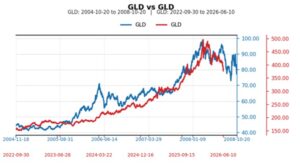
Gold’s four-year run from autumn 2004 to autumn 2008 looks awfully similar to its run from autumn 2022 to now. It was a deflationary bust that dragged gold down into October 2008 as the financial crisis hit:
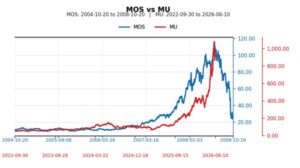
Back then, it was the fertilizers running geometrically as China bought up all the potash and nitrogen in the world.
Today, it’s the hyperscalers buying up all the DRAM. Here’s $MOS then versus $MU now:
This is where it gets uncomfortable.
Almost no one who was warning about deflation during the 2008 top could be heard over the shouting.
Home prices — and the property-tax receipts riding on them — were ratcheting higher, and we were told they always would.
By the end of 2009, property taxes were slashed across the country. Homeowner’s insurance cost a fraction of what it had a year earlier. Getting work done on your house in 2006 and 2007 came with an astronomical price tag, if you could even find someone to do it.
By the end of 2009, the market was flooded with contractors looking for any project at all.
It’s the exact same story, repeating verbatim, today.
The signs were everywhere in 2008, but they didn’t boast…
Frantic road-construction projects as towns rushed to spend every last tax dollar that had come in the year before.
Look around your own town — see anything similar? The social excesses, too: the Hummer H2, a beefed-up Tahoe built for suburban moms who wanted to feel like they were on patrol because the drive to the grocery store had gotten too mundane.
Nothing marked the top better than that thing.
Are you seeing this in your town?
Now look at your streets. I’ll bet you can’t drive across town without passing two Hummer EVs. The auto industry is writing off its wasted EV capex as we speak — Honda’s just the latest.
None of those signs announced themselves. The astute speculator had to watch for them and listen to the quiet voice within — the one that whispered: sell.
I’m watching, and I’m listening.
Being 90% long gold miners from 2023 until autumn of 2025 got me to where I am today, and I’m always hunting the next high-probability position to size into.
Right now, that position is cash.
My current portfolio holdings
I’m in 75% cash, with about 15% in gold miners left over from my last big trade, plus small trading positions in $ATUSF, $DAC, and $FTK after peeling some off over the past few weeks.
I’ve also got a small long-term hold in $VITL and a bigger one in $EPD.
As long as $SPY stays below its 8- and 21-day moving averages, I’m not taking on any new breakout trades. I’ll keep what I’ve got, trail my stops, stay in the upside, and run my game plan into August 2026 — when I think the real opportunities to size up will open.
My view is that those opportunities lie in an American renaissance: the one we were supposed to get after 2008, before money printing stepped in to prop up asset prices.
This time, there’s a possibility — however small — that Warsh doesn’t want to risk Fed credibility by printing alone. To keep asset prices from finding a true clearing value, you’d need coordinated QE from the ECB, BOJ, and PBOC, and I don’t think the central banks are as aligned as they were in 2012. I don’t think Warsh wants to expose the Fed as the wizard of Oz by printing only to watch stocks fall anyway.
Plenty of stocks will benefit in that renaissance once this contraction phase of the business cycle ends.
– $HURC could be one — it still trades around net asset value, even after its spike.
– $PRLB is another, poised to sit front and center of any manufacturing rebirth here in the U.S.
For now, I’m doing what I should have done in 2008. Not listening to the shouting.
Listening for the whisper. And right now, it’s telling me to wait.
By: Patrick G. Full-time independent trader in Atlanta, GA.
Patrick G is a full-time trader. Worked for a decade in a money management firm as a trader for high net-worth individuals.
He invested his and his family’s net worth into gold and mining stocks before the Covid money printing. Gold and commodity runs of the past 3 years allowed Patrick to trade full-time due to his gains.
Past performance does not guarantee future results. Trading involves significant risk of loss, and individual results vary. Positions mentioned are the author’s own, disclosed for transparency — not individual investment advice.

5 Days Free in a $7,000 Trading Room
Trade alongside David Prince live, Oct 26–30