
Big IPOs Are Big Business on Wall Street
I’ll never forget the lessons I learned about Wall Street during the Facebook IPO in May of 2012. I was the newest guy on the desk at a prop trading firm, and it was the summer of the PIIGS Euro debacle and Draghi’s “Whatever it takes” speech. It was a chaotic backdrop for the most anticipated IPO in decades. The FB offering was huge in terms of shares, and one trader on the desk had an allotment of shares in his personal account.
The offering price was $38, and in the premarket, it couldn’t hold above $43. The guy with FB shares was an amazing trader with superb instincts. He sold his shares at the open because he didn’t like the way the stock was acting. The stock had a brief spurt higher, then sank the rest of the morning. By mid afternoon, it was approaching the IPO price. We all saw how weak it was. We watched in amazement that there wasn’t any demand to keep the price above the initial offer figure of $38.
As the price slowly approached the offering price, more and more volume came on the offer. Massive quantities of shares were being dumped in the most overhyped IPO since the .com era. It seemed to take forever for the price to get down to $38. Penny by penny it sank listlessly. We all knew it was going to break below the figure, and then, out of seemingly nowhere, infinite sized bidding came in at $38. Every single share that was offered was met with an inert floor of demand at $38. Price never went one penny below the initial offer that first day of trading.
That was the underwriting syndicate bidding in infinite size for the stock. This is the lesson I learned that day:
Wall Street will not allow itself to look bad to the public. By sheer force of will, the money will be found to support shares that need to be supported to keep a proper image in the investing public’s eyes.
This is the way in which Wall Street professionals operate. A retail trader like myself can only watch in admiration at the way they handle their business.
I’ve never forgotten that day, and I’m reminded of it now as we move beyond the SpaceX IPO and into the IPOs of OpenAI and Anthropic. I still hold the view that we are in the contraction phase of the economic cycle, but I don’t think the market has a window to move down significantly until after August, and likely not until after the November midterms.
Those dates are far into the future, and not our concern for the present. For the moment, Wall Street has at least two more big IPOs to work through, and I am supremely confident that the professionals on the street will make the IPOs a success no matter what.
So while I am growing increasingly bearish as we move into the second half of the year, I am still aware of the realities of the business of markets, and it’s bad for business when stock prices go down.
I’m still in mostly cash, but you can’t make money if you don’t have a position so I’m looking for some positions that I can work into. I’ve analyzed all my trades for the 1st half of the year, and it’s amazing that March was my only down month considering how disappointing some of my entries and exits have been so far this year. The only reason I’m still in good shape this year is because I stick to a discipline. I intend to keep sticking to what has worked for me so far.
My discipline is to only buy two types of setups: technical breakouts in good price structures when the $SPY is above its 8 and 21 day moving averages, and large positions in stocks that I like fundamentally.
The breakout trades are tactical, and as such, I keep a constant risk size in those, without letting any position get bigger than about 7.5% of the total account. These trades produce positive cash flow on average and keep me involved in the game to feel how things are developing. These are generally less than a 3 month average holding period.
My position trades are different. Those are where the vast majority of my gains come from, can make up 90% of my account, and are generally a 9-18 month average holding period. Since we are not yet in a period where the $SPY is trending nicely above a rising 8 and 21 day moving average, I’m focusing less on breakout trades and more on working slowly into some stocks I think could weather the coming storm later this year.
I only feel comfortable holding large positions in stocks that I can analyze as having some compelling value. There’s several stocks I like in this regard. I’ve already shared the pipeline companies I like because their asset base is irreplaceable and should hold value through a downturn, then soar if and when the Fed is forced into yield curve control and inflation breaks out in the years ahead.
In keeping with the hard asset theme like pipelines, I’m also looking for companies that own assets and trade around book value. If the assets on their books are priced properly, they should have limited downside in the deflationary event that is my current base case.
Here are some stocks I’m stalking to find a small, low risk entry now with a plan to build a much larger position over time if these initial buys don’t get stopped out:
$RYN trades at 1.2x book value, and it yields about 5%. But it is tied to housing which I’m not bullish on until rates come down so I’m in no rush to take offers on this one. I’ll place small bids below the market once rates on the 10 year treasury find a good top.
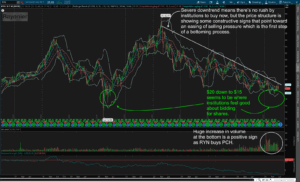
$NTR trades at 1.4x book value and yields 2.9% and has put in a good bottom at $60 so it has a nice defined risk with a stop under $60.
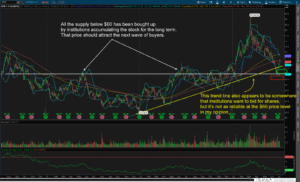
$RIG trades at less than book value, but it’s losing money this year. I think $RIG has institutional support for the stock at $4.50 so it would be nice to see one quick flush below the 200dma and then a quick pop back above to take a meaningful stake. I don’t know if we’ll get that so small sized bids are all I’m willing to do at the moment. I like how the $OIH peer group is coming into the 200dma for the first time since Venezuela and then Iran. It’s more reliable when the stock acts the same as the group.
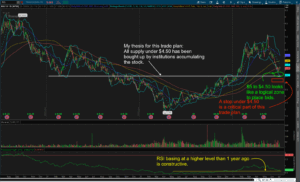
I’m in no rush to take on any big sized positions at the present, but as a professional speculator, I’ve got to have something on at all times, so I am willing to hold stocks that have some element of value and scarcity.
Hard assets like energy names, materials, and timber fit well into what I can analyze, have low risk entries on the chart, and offer discounted valuations if the policy response to the coming deflation is more printing. Their assets will not trade near book value if the Fed is forced into yield curve control and the Treasury is forced to issue tons of paper to pay entitlements.
Once the SPY and NDX get back above their 8 and 21 day moving averages, which I think they will as the professionals on Wall Street prepare for the big IPOs, then I can get back to taking breakout trades.
I’ve got a plan for that too, as I’m watching carefully the biotechs and pharma stocks which I think will get institutional sponsorship if we are in the contraction phase of the business cycle.
Normally, at this stage of the cycle, I would be buying consumer staples like $GIS, $SJM, $MKC etc, but their balance sheets are loaded up with “goodwill” that is anything but “good” in my opinion. I think they are going to have to take serious write downs on those fictitious intangible assets, or spin out the garbage dis-synergies on the balance sheet in hopes that passive investing will hold it for them. So I will stick to stalking pharma stocks as I mentioned previously.
The market is an endless stream of opportunity, and by shifting from tactical trading to strategic positioning when the market offers a spot to do so, I think we are getting a chance at real wealth creation and the shot at building a better life through asset ownership if we can deploy our capital wisely.
By: Patrick G. Full-time independent trader in Atlanta, GA.
Patrick G is a full-time trader. Worked for a decade in a money management firm as a trader for high net-worth individuals.
He invested his and his family’s net worth into gold and mining stocks before the Covid money printing. Gold and commodity runs of the past 3 years allowed Patrick to trade full-time due to his gains.
Past performance does not guarantee future results. Trading involves significant risk of loss, and individual results vary. Positions mentioned are the author’s own, disclosed for transparency — not individual investment advice.

5 Days Free in a $7,000 Trading Room
Trade alongside David Prince live, Oct 26–30