
This Is What Market Intervention Looks Like
It was many years ago, I can’t remember where (maybe in Market Wizards?), when I read that trading an equity position is like surfing: you feel the wave form underneath you, stand up on your board, and go along for the ride, shifting your balance to stay on long enough for the wave to carry you to shore. I was impelled to believe in the veracity of this mental image because it presented an idea of what trading was that naturally appealed to me: a skill that could be learned by doing.
There was something so wholesome about the idea that markets are organic, bound by unseen natural forces; that they conform to natural rhythms to which we can attune our senses and predict their ebb and flow and thus, that they can be capitalized upon by simply being in tune with their rhythm. Back then, I believed that guys who pulled wealth out of the markets were the ones that were best able to feel the current of liquidity in the markets, put on a position, and just ride the currents of capital flows in a primal, visceral way, stripped down from all intellectual embellishment.
When I finally made it to a trading desk in 2013, I was sitting next to the guys who “surfed” the market. They got rich by reacting to their natural instincts, formed over many years of operating in markets. But something changed that summer. That was the beginning of the QE era, where the natural forces of markets were overwhelmed by the dictate of central planners.
Everything about the nature of markets started to change that summer. That is when almost all trading converted over to algorithmic trading. Instead of riding the waves of capital on the open ocean, if you wanted to survive, you had to abandon your instinct to feel the wave form underneath you, to be in tune with the tides. Instead, trading became a game of waiting for the signal from central planners that liquidity was on the way. Like a wave pool at a water amusement park, we had to just get in and wait for them to turn on the wave machine. Our waves became man made, precisely controlled, and merely imitations of the powerful forces of nature. Even the seasoned pros on the desk were struggling to adapt to the new environment. We had to find new tools to help us regain a sense of balance.
It was the on the trading desk where I first learned the value of Twitter as a trading tool. Each of us had one of our six monitors dedicated to our lead trader’s Tweet Deck feed. He had a curated feed of the most important accounts on Twitter. Over time, as we were forced to adapt to the new market environment, we learned which accounts were the most valuable for their ability to cut through the noise and draw our attention to the signal. The lead trader’s favorite account back then was RedDogT3, Scott Redler’s Twitter handle – on my honor, a true story.
Red Dog was one of the first guys to flag a signal, a sort of poker tell the market would show before it succumbed to the algorithmic robots, bent to the will of the central planners, and began the grind higher for the day. Back then the signal was AAPL. Every day, no matter how bearish the set up was, no matter how weak the entire market was, if AAPL went green, as Red Dog would point out, we knew it was time to cover shorts and scramble to get long something.
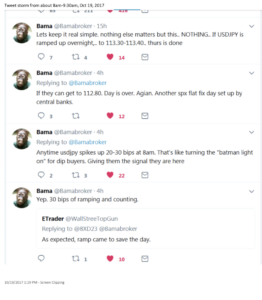
After I left the trading desk, I ran an equity portfolio for a small RIA shop, and Twitter was still a useful tool if you knew who to follow for the signal. There was an account called BamaBroker that got popular because he was one of the only guys to pinpoint another signal that became the market’s tell during the Yellen Fed. He called it the “Bat Signal” and it was the early morning, pre-market, 8:00 AM yen smash. If he saw the USD/JPY flash green at 8:00 after a spike down move, he knew it was the central planners’ signal that market prices were being supported that day by systematic yen selling. Back then, policy makers wanted a weaker yen to induce more of the yen carry trade on a daily basis. The yen was much stronger back then as it took only 113 yen to buy $1 vs the 160 yen it requires now.
Here’s a Bama tweet thread from Oct, 2017:
And here is the USD/JPY on the morning Bama’s tweet describes:
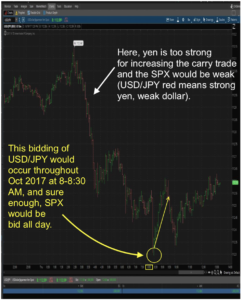
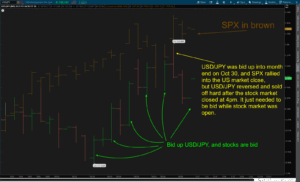
Below can be seen the correlation between the USD/JPY and the S&P futures back in October 2017. On days when the USD/JPY was bid up, the market was strong. When USD/JPY fell, the market couldn’t make upward progress.
USD/JPY vs SPX in Oct 2017 (with yen intervention days annotated in green):
Bama was an anonymous Twitter account until he got doxed one day. It turns out his dad ran a fancy RIA. Bama was rumored to be trading the ES in huge size and making clients good money, but his tweeting about it was a bad look for an old, blue blood, Southern gentry type of advisor. Bama’s account went dark and never returned. For many years I haven’t thought about the lessons I learned from his tweets. That is until this week.
A couple weeks ago I wrote about Bessent’s intervention that squeezed me out of my SPY short. That was the first sign that bearish conditions would not be allowed to develop, and this past Wednesday, early in the pre-market, I saw the Bat Signal once again.
USD/JPY this past Wed, Aug 19th:
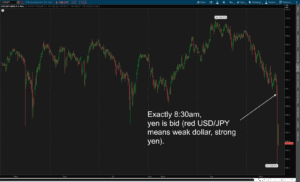
S&P 500 futures at the same time:
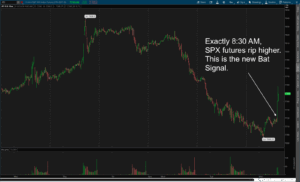
This time, however, the Bat Signal is just the reverse of what it was in 2017 when Bama brought our attention to it. Now, the yen is far too weak, and the normal policy response to stop a weak yen would be for the Bank of Japan to raise rates. But that would make the yen carry trade less profitable and reduce demand for US stocks, so raising rates in Japan is not desirable for policy makers. Now, it’s a strong yen (USD/JPY down) that acts as the Bat Signal. The policy makers are leaving their interventionist tracks all over the tape with the 8:30AM yen buying.
I believe we’re entering back into a period of intervention in market prices that was the hallmark of the Yellen Fed period, at least until the mid term elections are over. That means I expect that at crucial moments where the market is about to crack, we’ll see the Bat Signal light up the night sky and a mysterious, unidentified, masked defender will show up out of the darkness to save asset prices from a swoon.
If I’m correct about my assessment of the general conditions in the market going forward, then my style of trading, of feeling the waves form, building a large position, and riding it for as long as I can will not be a favorable approach. Shorter term trade set ups like TEVA that I detailed last week will be more the order of the day. Even shorter term styles like scalping and day trading on the long side will likely be more successful in this type of environment. Unfortunately, those styles lie outside my circle of competence, so I’ll be sitting out of the game unless I see a set up with my criteria.
I’ve still got a large chunk of gold miners but I think this rally will fizzle out near $4,770 and head back down again. I won’t be interested in building back my gold miner position until $3,825 in gold. I think the lowest we’ll ever see gold is $3,120, and I’ll build back up my position entirely down there. I’m still very bullish on gold into 2028, but I’m not feeling a good wave form at the moment.
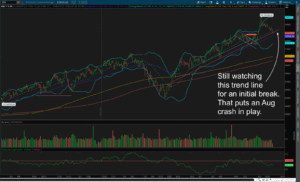
I’m also still very bearish on the market, and I’m keeping an eye out for my August crash scenario in the Dow, but I’m ever so cognizant of the policy makers’ abilities to influence price in the short term so while I don’t assign a high probability of a crash this year, I will be on the look out for an initial break in the DJIA, followed by a failure to get above the initial break level.
I’ve also got my energy and agriculture names, but my need to pay monthly expenses is weighing on my better judgement. I don’t think I’ll be able to build bigger positions at lower prices in those names so the urge to peel some off and lock in profit to maintain cash flow every month this year is welling up inside of me. Maybe it’s OK to let a little wave pass beneath you while you just sit on your board waiting for the big one…
Right now cash is sill my largest position. I’m getting paid 3.5% while wait for my next campaign, when I can put on a large position in something I’ve got an edge in, and ride that wave all the way in to shore.
_________________________________________
By: Patrick G. Full-time independent trader in Atlanta, GA.
Patrick G is a full-time trader. Worked for a decade in a money management firm as a trader for high net-worth individuals.
He invested his and his family’s net worth into gold and mining stocks before the Covid money printing. Gold and commodity runs of the past 3 years allowed Patrick to trade full-time due to his gains.
Past performance does not guarantee future results. Trading involves significant risk of loss, and individual results vary. Positions mentioned are the author’s own, disclosed for transparency — not individual investment advice.

5 Days Free in a $7,000 Trading Room
Trade alongside David Prince live, Oct 26–30