
Treasury Secretary’s Memo to Market Bears: Drop Dead.
The short setup into the FOMC decision last week was one of the best I’ve ever seen: during an ominous time of the year where crashes occur, the stock market was being pushed closer to the edge by 10yr US Treasury bond rates rising in response to pressure on the Bank of Japan (BOJ) to hike rates and in response to pressure on the Japanese Ministry of Finance (MOF) to sell dollar assets to buy yen in order to stop yen weakness.
I had been on the lookout for a rate hike by a foreign monetary authority that would cause the initial break in the market which could lead to a crash just like the 1987 and 1929 crashes, both of which had foreign bank rate hikes as the catalysts.
The BOJ was the obvious candidate for a hike as their currency was in free fall, and their domestic population was clamoring for authorities to stop the pain. The MOF would normally intervene in the FX market by selling US Treasuries to buy yen, but that option was off the table as Scott Bessent can’t have rates in the US rise. I thought the BOJ would be forced to hike, which would pull money out of US assets and into Japan. I laid out my reasoning for a low risk short and was short the SPY from just above $740.
Instead of a BOJ hike, what we got was a coordinated intervention between the US and Japan with Scott Bessent as the front man, complete with a full media appearance tour and planted photos of Bessent’s memo pad detailing his secret plan to buy yen for $5-$10B.
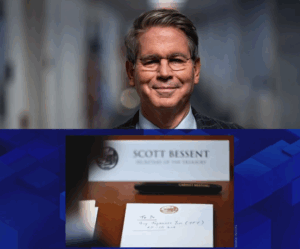
Bessent’s move was a masterful stroke that averted a crisis in the stock market by offering Japan a reprieve without requiring them to either hike rates or sell Treasuries. The very public announcement that the US will not allow the yen to weaken further was enough to put the squeeze on shorts like me (fortunately, I followed my plan to cover and took a 2.5% loss).
Bessent’s public statement in support of the yen is enough to take any notion of shorting this market off the table for now, but it also revealed the Achilles heel of the entire global financial system: the yen carry trade.
We caught a glimpse of the importance of the yen carry exactly 2 years ago when the BOJ was forced to raise rates off the zero bound to 0.25%. On August 5, 2024 the SPX gapped down, and a full blown melt down was a real concern. The BOJ helped calm the panic by promising not to raise rates again any time soon. The panic level was high enough for Jamie Dimon to release an absurd statement that most of the yen carry trade had been unwound, and there was no reason to be concerned about a market melt down. Jamie is too smart to think that’s true so it’s obvious he was being compelled to sooth the highly leveraged speculative community and their brokers and to convince them to ease off the short yen covering and margin calls.
The dire situation of a yen carry unwind was allowed to grow acute in August 2024, but Bessent was taking no chances this time around in 2026 and preemptively intervened before the stock market could weaken. In doing so, he revealed the lynch pin to the asset price bubble we now find ourselves in, and while he may have relieved the pressure building up to that point, neither he nor the BOJ did anything to alter the underlying dynamics of the situation.
While Bessent may have altered the path we are taking, I don’t think he was able to change the ultimate destination at which we will eventually arrive: a significantly lower stock market. I think this short squeeze will buy enough time for Wall Street to get out two more big IPOs: OpenAI and Anthropic.
One of the greats, Paul Tudor Jones, lays out his case for why those IPOs will likely signal the top in the market. I’m not as smart or as rich as PTJ, so I’ll just adopt his opinion until he changes it. I won’t have a chance at getting anywhere near as rich as PTJ if I dig my heels in on the short side. I’m still bearish, but I’ve got very little trading inventory left to sell and way too much cash if this is the start of a melt up into the IPOs.
As bearish as I’ve grown the past month, I managed to resist the temptation to prematurely sell what few longs I’ve got until the time was right.
FTK was an easy ride until the recent sell off from $27 to $22, but I reviewed my trade plan when the temptation to bail out of the trade seemed to be on the verge of overpowering my holding discipline. It was a gamble holding over earnings, but I figured the odds were on my side based on the monthly chart and the acceleration in business described on its last report. The bet paid off.
DAC was another great win that I locked in this week.
With these two trading positions moved out of inventory, I’ve only got a little bit of ATUSF, NTR, XOM, and CVX left in long inventory. I’ve still got a large chunk of the gold miners as long term position trades I put on in 2023.
My trades in FTK and DAC are a reminder to myself that my process works. I have a strict set of criteria for putting on longs and sticking to that discipline has been profitable all year.
I’ll only buy stocks when I get the setup I’m looking for, like FTK at $18, DAC at $100, MT at $34, ATUSF at $20, XOM at $120, or CVX at $156.
If you look at those on a chart, you can see the tight price structure I am looking for. If I see that price structure combined with the SPX above trending 8 and 21 day moving averages, my discipline says buy. If I don’t see that, my discipline says stay out of the game.
Right now, I just simply don’t see that structure in any stock. I find nothing that deserves my irreplaceable capital. I’ve given up years of my life to slowly acquire my capital, and it’s cost me greatly in terms of a life that might have been, had I not been so obstinate about becoming a speculator. For me, the cost of capital wasn’t measured by interest cost, but by life experiences forgone. I refuse to risk my capital in a game that isn’t stacked in my favor.
So I’ve got one big position on right now, and that is cash. I don’t think diversification will get you wealthy in speculation, so I tend to, out of necessity, have very large, concentrated positions. As soon as I get a hold of something that is working, I’ll pile in as large as I can. Right now I see more opportunity on the short side than anywhere else, but it’s not working. So I’m letting my cash position grow as I peel off the last remaining trading positions I’ve got.
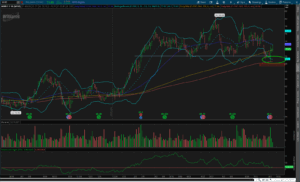
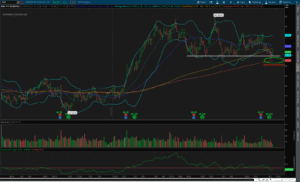
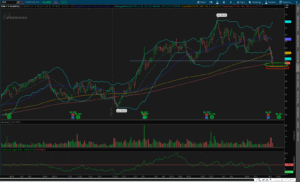
However, with the possibility of a melt up in the SPX, the 8 and 21 day moving averages could both curl up and trend higher, so I’m on the look out for longs I can get into. The pipeline companies I’ve mentioned earlier this year are nearer the buy points I was waiting for. The stocks are not cheap so I’ll be frugal with my bids and tight on my stops. I’m in no rush to put on size right now, but it’s still my view these stocks could hold value during the money debasement to come in the years ahead.
WMB:
KMI:
ENB:
We also got the update from ABNB that I wrote about towards the end of the note last week. Hospitality has been the only other underinvested industry besides energy over the past decade. I think ABNB will be taking share from traditional hotels for years to come. This breakout looks clean, and the stock can be bought on weakness with a stop under $150.
ABNB:
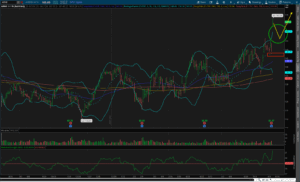
I’ve always leaned bearish. It’s just the way my mind works. But having been a bear so long I’ve come to understand something crucial about operating on the short side: if a guy with way more money than you is on the other side of your trade, you better listen to him when he says he intends to bury you. If you’re shorting the SPY, Bessent is on the other side of your trade, and his message is loud and clear.
_________________________________________
By: Patrick G. Full-time independent trader in Atlanta, GA.
Patrick G is a full-time trader. Worked for a decade in a money management firm as a trader for high net-worth individuals.
He invested his and his family’s net worth into gold and mining stocks before the Covid money printing. Gold and commodity runs of the past 3 years allowed Patrick to trade full-time due to his gains.
Past performance does not guarantee future results. Trading involves significant risk of loss, and individual results vary. Positions mentioned are the author’s own, disclosed for transparency — not individual investment advice.

FREE Training
3 Ways to Find Big Wins Starting Now