
SpaceX: The Hard Questions Are Here
Peace is coming (hopefully) to the Middle East, sending oil lower while equities stabilized.
But if you expected a sleepy summer, you're disappointed.
Because this market remains action-packed. So let's talk about what's happening:
SpaceX Comes Down to Earth
Last Friday, SpaceX (SPCX) came public in the biggest IPO of all time.
And it hit Earth with a bang.
The deal priced at $135. The stock opened at $150 on the dot and hit a high of $225.64 on Tuesday, from where it started sliding:
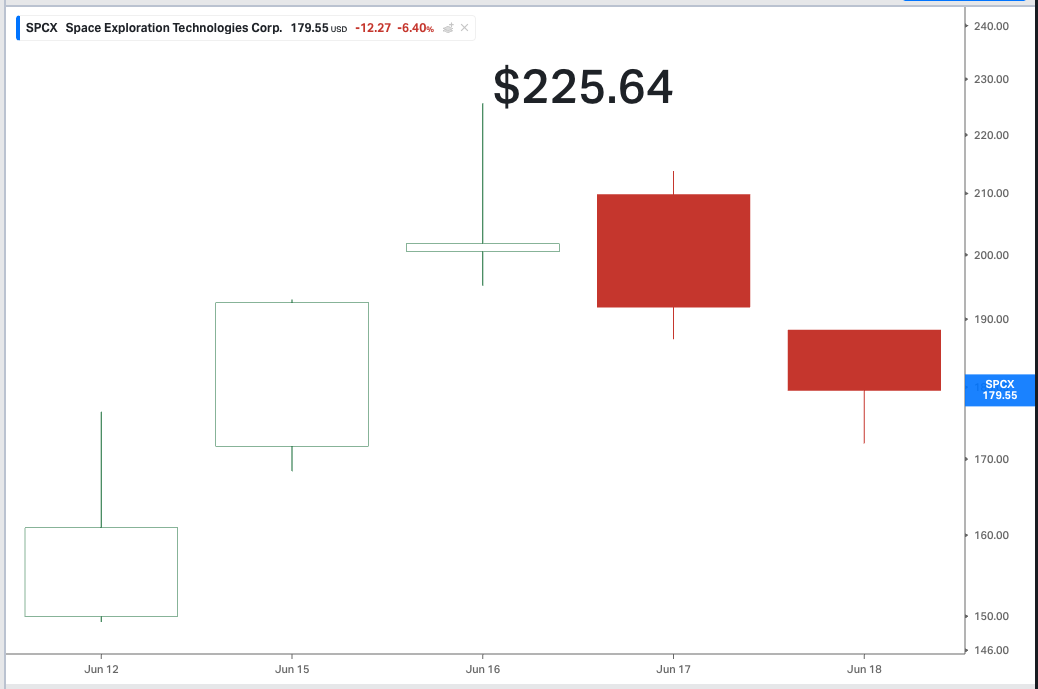
Even after this 20% drop, its $2.36 trillion market cap is larger than:
- Broadcom (AVGO)
- Tesla (TSLA)
- Meta (META)
- Micron (MU)
- Walmart (WMT)
- JP Morgan (JPM)
Analysts expect SpaceX to grow revenues from $35.9 billion this year to $130.9 billion in 2029. Elon Musk himself said he expects SpaceX to generate about $1 trillion in revenue in 2030.
But now the tough questions are coming:
- Was the entire rally engineered through limiting the supply of stock and giving more retail traders access to the IPO?
- Can Elon Musk sell SpaceX the way he's sold Tesla?
- Even if SpaceX can hit growth targets, is the valuation out of control?
- Will the stock collapse when insiders get the green light to sell?
- Will the company have to raise even more capital? There are now reports of a potential $20 billion bond offering on the way.
I own a whopping 10 shares of SpaceX myself. And I'm thinking about selling, and buying some out-of-the-money puts.
Because if SpaceX crashes, it's bound to be ugly.
JR Romero had some harsh words for SpaceX (the stock, not the company) here, and we went deeper into the potential dangers facing this iconic name:
The Epic Semiconductor Run Won't Stop, and Has Another Catalyst
The VanEck Semiconductor ETF (SMH) might be incapable of going down.
It's up 83% this year and hit another record high on Friday thanks to big moves in names like Intel (INTC), Taiwan Semi (TSM), and AMD (AMD).
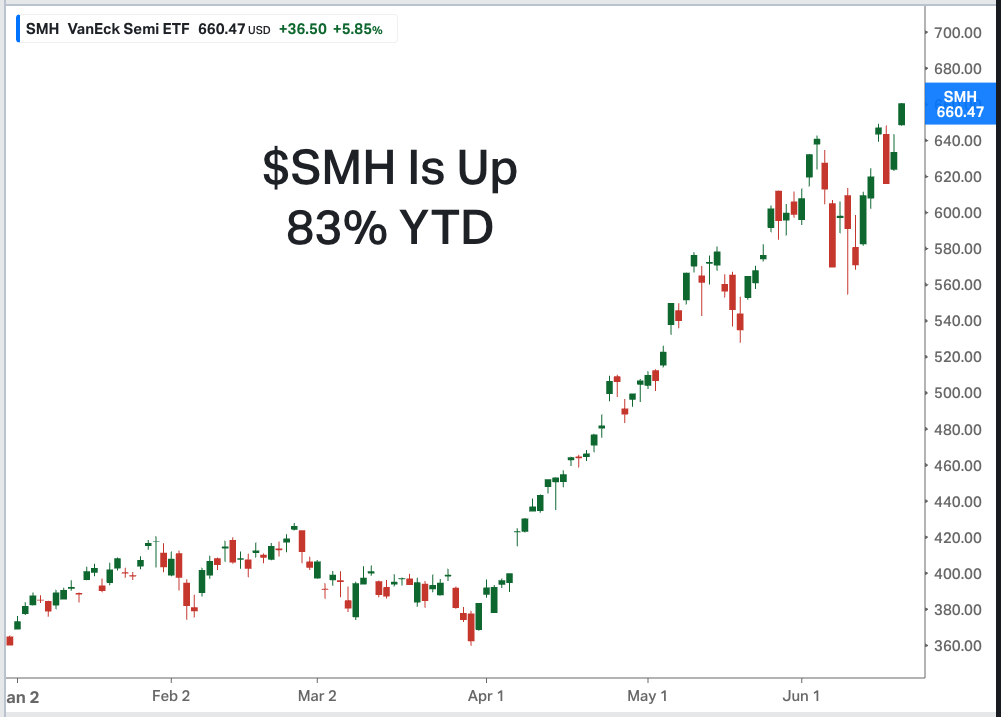
And it would be up even more if SanDisk (SNDK) was in the ETF.
SanDisk is the #1 stock in the S&P 500 this year with its 819% gain.
Plus, there's another catalyst on the horizon: Micron's (MU) earnings report on Wednesday after the close.
Based on the number of AI-related capital raises we're seeing from the likes of Alphabet (GOOGL), Nvidia (NVDA), SpaceX, and others, demand for memory remains insatiable.
So Micron should extend what's been a monumental winning streak for semiconductor earnings.
Warsh Confirms the Drift Towards Higher Rates
New FOMC Chairman Kevin Warsh made a big splash at his debut meeting on Wednesday.
Warsh shortened the post-meeting statement, ditched the dot plot, announced five new task forces, and declared war on inflation.
Warsh's hawkish show came as a surprise to many because he was viewed as a loyalist to President Trump, who has been vocal in wanting lower rates.
And 9 of 18 Fed officials now expect at least one rate hike this year.
The market was already leaning in the direction of higher rates, and the Fed reinforced that.
Now markets are pricing in an 85% chance of higher rates by year-end, according to the CME's FedWatch Tool.
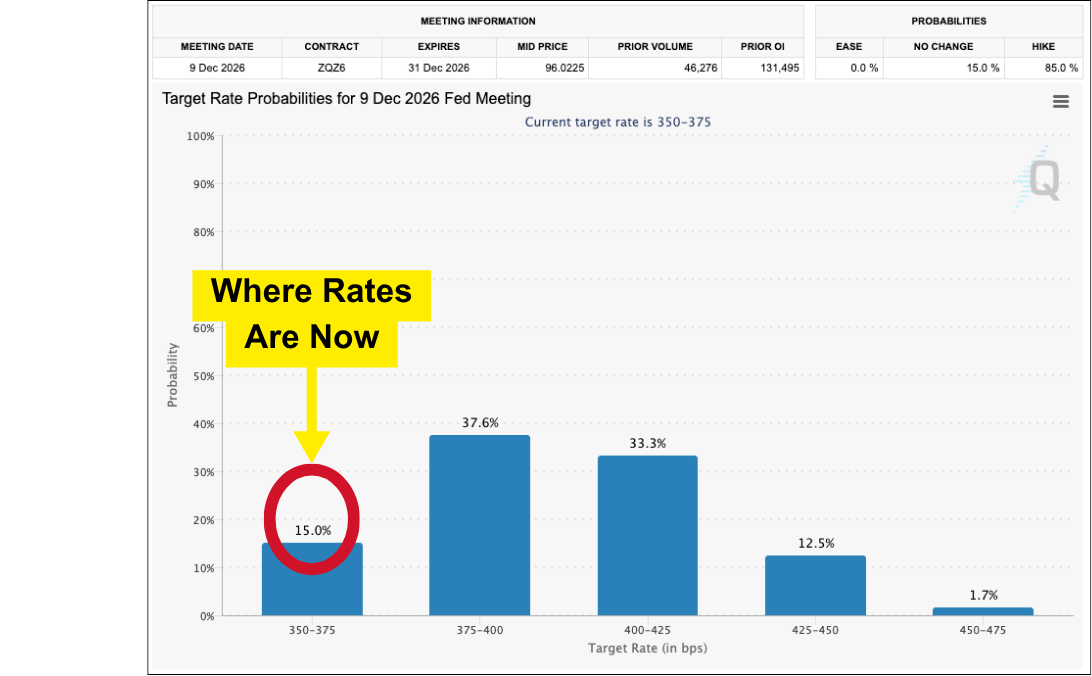
So the breakdown of expectations is now as follows:
- 15% chance of rates staying unchanged
- 37.6% chance of 25 bps in hikes
- 33.3% chance of 50 bps in hikes
- 12.5% chance of 75 bps in hikes
- 1.7% chance of 100 bps in hikes
This isn't a major change from last week. It was more a reinforcement of what the market is looking for.
Still, I'm eager to see if the President starts tangling with the independent-minded Warsh.
Stocks Go Up, Traders Go “Meh”
The latest AAII Sentiment Survey shows that 36.6% of investors are bullish.

This is up from last week.
But it’s still the 5th straight week of below-average bullishness. That's even with equity markets hitting record highs, and a US-Iran deal coming together.
Meanwhile, CNN's Fear & Greed Index is at 37, smack dab in the Fear category.

But overall, the numbers are healthy because it shows that not everyone is bought into this rally.
The last thing we need is euphoric sentiment, which typically happens around tops.

5 Days Free in a $7,000 Trading Room
Trade alongside David Prince live, Oct 26–30