
Bull or Bear? Pick a Side and Fight
Have you ever wondered why we refer to the daily battle of buying and selling that takes place on Wall Street as the bulls vs. the bears?
I think it has to do with the nature of each beast’s relationship to man. A bull sees its target, puts its head down and horns up, and charges ahead no matter what obstacle is in its way. A bull doesn’t stop until it either kills or is killed by the matador. A bear spends much of its time in hibernation and hiding, and it only makes its presence known at the moment of attack. A bear keeps away until a victim enters its territory.
In trading we’ve got to take the same approach as these two beasts. If we do the work and determine that we should be bullish, we’ve got to charge ahead on the long side and disregard obstacles. If you’ve ever been long a stock that was charging higher, you know how great the temptation can be to sell early and lock in profit to make sure it doesn’t slip away. Ignoring the negatives in a real bull trend higher is a difficult skill to attain, and perhaps the best we can do is try to hold on a little longer each time we’re in one. In the same vein, if we do the work and determine the appropriate stance is bearish, we’ve got to wait for the market to come into the area we want, then attack and leave. Bulls charge relentlessly, and bears maul swiftly. This is the proper way we should think about our own trading.
Each one of us has to determine for ourselves whether we are bullish or bearish. There’s much work that goes into that conclusion, but once we’ve chosen a side, we must use our capital to fight.
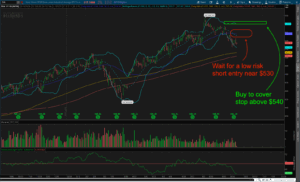
As for myself, I’ve determined that the appropriate stance for my irreplaceable capital is on the bear side. I’m in 75% cash and waiting for a spot to short. I’m waiting for price to come into the area I want, about $53,000 on the Dow Jones Industrial Average, and then like a bear, I’ll attack. The market is leaning bullish now with the SPX and NDX breaking higher so the DJIA could get nearer the $53K level in the last weeks of September or by the first couple of weeks in October. I’m looking to short the DJIA ETF, the DIA, at around $530 with a tight stop above $537.75 which is the high for September. Above $540 on the DIA and I’ll flip to bullish and scramble to get long something. I’ve also incorporated a time stop into my trade plan: if stocks haven’t started to decline by Halloween, I’ll abandon the bear side for the rest of the year. I’m not going to hold on to a losing position just because I’ve done a thorough analysis and decided I’m bearish.
DIA Trade Plan:
But what exactly are the facts that give me a reason to be bearish? Merely being “concerned” about stocks’ advance is not a rigorous analysis. Professional speculation requires real analytical work, especially when trying to pinpoint a bull to bear turn.
I’ve done the work that leads me to the conclusion that there’s a near picture perfect analog to the 1929 and 1987 crashes. I’ve kept a checklist of signs to indicate when the turn in the business cycle is approaching, and I’ve been keeping an eye out for the anecdotal evidence I remember from the 2008 crash like constant road construction as municipalities rush to spend the record high tax revenues from a previously booming economy and signs of excess like the Hummer EV, which is a nearly exact replica of the sign of excess of the Hummer H2 I saw in the housing boom leading up to the 2008 crash. But a proper analysis requires more than just anecdotal evidence to be taken seriously. So I’ll present my bear case here for anyone to pick apart. Below is a video showing my analysis of the 1929 and 1987 crashes and how they resemble the current market in 2026.
1929 and 1987 Comparison to 2026 video:
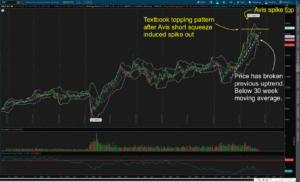
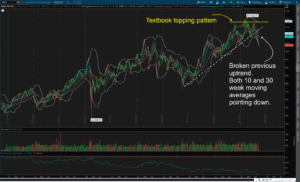
In addition to the historical October crash analogs, I see further evidence that we are in the early stage of a bear market when I look outside the popular stocks. Aside from several mega cap technology stocks, the underlying market health has been deteriorating for some time. The transports and utility stocks are not confirming any of the bullish narrative. On the contrary, they are looking more like tops. I’ve never seen a bull market in stocks work out with the transports and utilities in a compromised price structure like they currently exhibit.
DJT:
DJU:
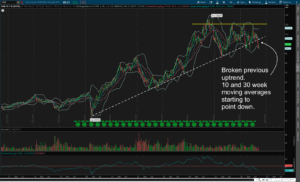
The housing stocks are also showing stress. Housing is a major driver of consumer spending which is 70% of our economy. With Warsh’s latest rate increase, I don’t see how housing will pick up without a major move lower in house prices. Neither higher rates or lower prices are going to be supportive of higher economic activity in the short run.
XHB:
Warsh’s latest rate hike also reminds me of 1987. Alan Greenspan was selected as the new Fed Chair in August of 1987. He thought that business activity was too hot and consumer prices were about to skyrocket so he took rates from 6.5% in August to 8% by October 1987. The rate hikes proved too difficult for the bull market to charge through. The rate hikes were the banderillas thrust into that bull market’s back to wound it, and Treasury Secretary James Baker’s October 18th remarks that he would tolerate a much weaker dollar in response to the Bundesbank’s rate hike was the estocada, the fatal blow delivered to the bull market. Stocks crashed the next day. So far, Warsh’s tenor as Fed Chair is a great analog to Greenspan’s just before the 1987 crash.
Aiding my bearish stance is the fact that we’ve got the curious case of the AI IPOs that don’t seem to be materializing. This reminds me of the “Viceroy moment” in the Dutch tulip bubble. The most expensive tulip bulb ever bred, the Viceroy, came to market and couldn’t clear the reserve price. It was a failed auction, and the tulip bubble popped. I’ve already shown why I think the AI narrative is not matching what is going on at the ground level with many stocks that should be benefiting from an AI buildout, and now we keep getting delays in the Anthropic and OpenAI IPOs. They're begging the government to regulate them (and their competition) looks to me like the tell that we’re headed for a Viceroy moment with the AI narrative.
While all these negatives weigh on my mind, perhaps the most dominant part of my analysis that is leading me into the bear camp is valuation. I can’t find a single large cap sector that has any investment merit whatsoever. It’s almost like the mirror image of a stock market bottom where the news is awful, but stock prices are so low that all likely future negatives are priced in. Stocks are in a position now where the news seems wonderful, but stock prices are so high that all likely positives are already priced in. Energy was the only cheap sector earlier this year, but the rally since March has removed most of their attractive valuation. The only sector that appears cheap is the chemicals, but they are cheap because the long term value of their business is impaired as China has gone from an importer of their products to a massive exporter of lower cost commodity chemicals.
Stocks as an asset class are extraordinarily expensive, and the marginal buyer at the moment is the passive “investor” which ironically is performing none of the actual work of investing when they buy a share of an index fund. Investing is a skill that requires effort, but the passive investing cohort has removed effort from their investment process. They’ve made stocks into a financial product upon which fees can be generated. This is a dangerous mentality to have towards a fickle asset class like stocks.
The only asset class that is cheap is US Treasury bonds, and those are in a severe downtrend for now. I’m bullish on USTs in the form of TLT, but I’m in no mood to fight the market right now. I’d like to see a tradable bottom before I take another attempt at getting long. The work I’ve done leads me to conclude that the only proper stance on USTs is the bull side, but until the market agrees with me, I’m not taking any position. I’ve chosen a side on the TLT, fought with my capital, lost that skirmish, and I’m regrouping to fight another battle when conditions favor my success.
My trade in gold from Oct 2023 to March 2026 was what afforded me the opportunity to try my hand at professional speculation full time so I’ll always be fond of the metal, but I don’t see anything that interests me in gold until its price moves much lower towards $3,825.
The only asset that is working for me at the moment is cash, and I’m getting paid 3.5% to just wait for the right conditions to put my capital at risk.
The stock market seems like an unprepared camper that has wandered into bear country, left a mess all over camp after dinner, hasn’t tied up his food supply, and is begging for a bear mauling. The time will come when the next bull market will begin. The seeds that are the underlying forces that will cause the next bull market are already being sown; housing is the major driver of the US economy. Home prices are sky high because we need more housing, but housing starts are at depression levels. The next stock market crash will make timber, lumber, and building supply stocks irresistibly cheap. I’m watching housing stocks like a hawk for signs of the next bull market. Stocks like WY, LPX, BCC, IBP, and WHR will show us when the business cycle is about to turn from slowdown to initial recovery. When that moment comes, it will be time to flip bullish, jump on, and try to ride the bull without getting thrown off.
Lastly, a word of caution: please do your own research before placing a dime of your hard earned money into this market. Everything I write can only be considered as data for your own analysis. Nothing you have read here is investment advice, which is personal to your own circumstances that you should discuss with a trusted advisor. I am a speculator, and I take risks with my own capital that I would NEVER suggest others to take.
_________________________________________
By: Patrick G. Full-time independent trader in Atlanta, GA.
Patrick G is a full-time trader. Worked for a decade in a money management firm as a trader for high net-worth individuals.
He invested his and his family’s net worth into gold and mining stocks before the Covid money printing. Gold and commodity runs of the past 3 years allowed Patrick to trade full-time due to his gains.
Past performance does not guarantee future results. Trading involves significant risk of loss, and individual results vary. Positions mentioned are the author’s own, disclosed for transparency — not individual investment advice.

ATTN: Serious Options Traders
There Is Just ONE Epic Trade Every Week