
Desperation for Dollars and Liquidity
The Nasdaq 100 has gone nowhere for 4 months. Trillions in market cap is simply treading water. The price weighted Dow Jones Industrial Average has been declining for 2 months. Its two largest components are GS and CAT at $900 and $800 respectively. Both topped out over two months ago. The next largest component, MSFT, is a $500 stock, and it put in a 52 week high almost a year ago with a double top completed in Oct, 2025. While the SPX and NDX are near highs, the number of stocks making new 52 week highs is sinking lower with every rally in the averages. The number of new 52 week lows is expanding with every impulse higher in the averages. This is an unhealthy market.
Insiders in many of the stocks I follow have been selling their shares all year while they use shareholder equity to do share buy backs of the very same shares they themselves are selling out of their personal holdings. The insiders know what their stocks are worth, and they are voting with their own money. Valuations of stocks in every single sector are far in excess of the average earnings power an owner of those shares can expect to receive over 15 or more years. This is an expensive market.
It’s the banking sector that is most troubling from a valuation perspective. As the rate on the 10yr US Treasury Bond rises, the assets that sit on the regional banks’ balance sheets deteriorate in value. In the depths of the SVB crisis in 3Q 2023, regional banks were holding unrealized losses of $675B on their books vs $2T of equity capital. Rates are now higher than they were then. We changed accounting rules for “held to maturity” assets then so we could pretend our banking sector was solvent, and we must continue to pretend now even though their assets are presumably worth even less than during the SVB crisis. We’ll have to wait another month to get the total unrealized losses sitting on regional banks’ balance sheets after this most recent rise in rates. The potential exists that one third of our banking system’s equity is impaired in long duration assets they can’t sell from their books. This is exactly what happened in the S&L crisis in the 1980’s. The savings & loans went bust, and the banking system created the collateralized debt obligation security market to package up all the low interest rate loans no one wanted to buy in a high rate environment. We later realized this was in part the origin of the 2008 GFC, as the CDO market went into overdrive by the early 2000’s. This time however, the impaired assets aren’t held by a niche corner of the banking system. The impaired assets make up a major portion of all regional banks’ balance sheets.
The stock market seems to be in a state of suspended animation. The SPX and NDX seem like they want to breakout higher. The DJIA, DJT, DJU, and RUT aren’t in a mood to follow. The market needs a catalyst to move in either direction. I think there’s only one bullish catalyst that could propel the market higher: an end to the Iran situation and a resumption of trade relations with China. There are rumors leaking out now that indicate we could see that, but even if that news does come out soon, the market should look right past that to post midterms when the conflict is almost sure to resume. Any rally on Iran or China news should bring the DJIA back up to the $53K level I’ve been watching to short. In fact, I’m counting on a rally in the next couple weeks to test out my theory on an October crash. A failure for the DJIA to trade above $53,700 before Halloween makes a crash a high probability event by my analysis.
While there’s plenty to dislike in this market, there’s three interrelated forces I see driving the current environment. The stock market is being ruled by a triumvirate of higher rates, a higher dollar, and lower liquidity.
Rates are going higher across the developed world. Only China is not seeing rate increases. The most common explanation for the higher rates is that global growth is picking up, but I can’t see any indication of that accelerating growth in the stocks that should be benefiting from growth. The growth explanation to rising rates floats like a lead balloon. The real reason rates are going higher is simple: asset holders are selling their bonds to raise the much needed dollars to keep up with rising borrowing costs.
As the DXY rises above $101, we are witnessing the scarcity of dollars in real time. Every penny above $101 is another tranche of demand pull away from financial assets. A plethora of dollars means lots of potential demand for financial assets that can go into stocks and support prices. A scarcity of dollars implies the opposite.
Without the willingness to freely supply dollars, liquidity in the financial system is drained, and asset prices are vulnerable. No asset is more vulnerable than an absurdly expensive stock market that has to compete with short term US debt for income. Long term holders of stocks are sitting on massive gains. They’re eyeing the real rates they can get by switching into bonds now.
Real rates are over 2% now and increasing. Due to these higher real rates, bonds are acting as competition for increasingly scarce dollars that need a home. Gold is sinking as real rates rise. Gold is showing us the future path for stocks unless policy makers respond with liquidity creation soon. I’ve always followed the gold signal, and right now, gold is telling me there is a deflationary event on the horizon. It’s been my view for some time that the deflationary event is the end of the current business cycle.
The business cycle is obviously entering into the contraction phase, but Warsh raised rates, and the market thinks he’s going to raise again in the next meeting. There must be at least several thousand PHDs at the Fed that are smarter than I am, and if I can see the danger present in the stock market, I know they can as well. They must see, like I do, that economic growth is incredibly fragile and nearing a peak. Why are they insistent on hiking rates? Nothing adds up, and the only position I feel comfortable with is cash. I’m staying in 75% cash until I see more charts set up like I want.
There’s a chance that we get more policy intervention right when the market is about to succumb to higher real rates, and in that case I’ll have to chase stocks higher. I’ve got a watchlist of names I’ll rush to buy on the first sign of intervention that averts an October crash.
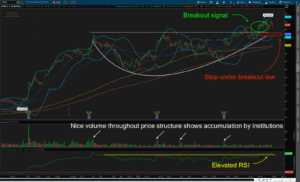
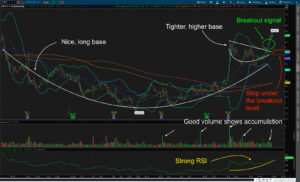
I’ve liked the chart of TEVA for some time. It still looks good, but it’s logical stop is still at $36. CRCT is setting up nicely as well and has new hobby and craft products which should continue the trend of higher sales and increasing gross margins, but this one is getting away from its logical stop. These are names I’m looking at only if I’m forced to chase stocks higher, which is a real possibility given the recent bouts of intervention at key turning points in the market.
TEVA:
CRCT:
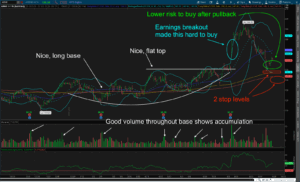
Another name that is in a lower risk position to be bought is ABNB around $150 to $160. 2025 was a good year for ABNB as revenue and booking value saw strong growth after a two year period of weakness. The momentum continued into the first two quarters of 2026 as well. The company is branching out into new areas to become more than just a vacation rental app. They noticed that many of the guests that stay at a rental house booked through ABNB also use Uber and DoorDash services so Airbnb has started to offer similar proprietary services through its own app. This is transforming the company into a broader travel platform that makes sense. Uber or DoorDash would have less success at branching out into vacation rentals after they have structured their businesses around their respective niches, and it would be much harder to scale up into vacation rentals than to scale down into car rental and food delivery. As ABNB gains experience at operating the new business lines, they could become a one-stop shop for travel experiences. They would have a scale that couldn’t be matched by any other competitor. ABNB is also showing real cost reductions from AI. It’s seeing customer support costs decrease as AI is able to help almost half of customer calls. ABNB’s growth comes at a cost however, as it is a very expensive stock. This one’s logical stop is underneath the recent lows, but more logically, a smaller position could have a stop under the 200 day moving average with the same dollar risk.
ABNB:
For the moment, I don’t feel comfortable in anything other than cash. I’ll take some short term trades in setups similar to the three stocks I’ve mentioned above, but for the most part, my mind is preparing to get short on the next rally should it stall out at $53,700 on the DJIA. I see only temporary measures coming from policy makers. They don’t want to do any real policy making other than bail outs and interventions. Allowing the markets to go through actual price discovery for the first time since 2012 would do a lot of the heavy lifting for policy makers. A price reset would remove assets from weak hands and transfer them into strong hands. Human nature would take care of the rest.
Lastly, a word of caution: please do your own research before placing a dime of your hard earned money into this market. Everything I write can only be considered as data for your own analysis. Nothing you have read here is investment advice, which is personal to your own circumstances that you should discuss with a trusted advisor. I am a speculator, and I take risks with my own capital that I would NEVER suggest others to take.
_________________________________________
By: Patrick G. Full-time independent trader in Atlanta, GA.
Patrick G is a full-time trader. Worked for a decade in a money management firm as a trader for high net-worth individuals.
He invested his and his family’s net worth into gold and mining stocks before the Covid money printing. Gold and commodity runs of the past 3 years allowed Patrick to trade full-time due to his gains.
Past performance does not guarantee future results. Trading involves significant risk of loss, and individual results vary. Positions mentioned are the author’s own, disclosed for transparency — not individual investment advice.

ATTN: Serious Options Traders
There Is Just ONE Epic Trade Every Week