
Are You In The Biggest Trade In The USA?
There’s an aspect of human nature that makes us want money for nothing. Even the workaholics among us would gladly find more leisurely pursuits for their high-strung energy if the money rained down and into their coffers. Speculation is hard work, but many novices get into trading thinking all they’ve got to do is turn on the computer, open a brokerage account, and the money will come pouring in.
If you’re reading this, you know that’s not how this works. As traders, if we want to make money, we’ve got to do the work and take risk. Taking risk is hard, because it makes you vulnerable to loss, but risk is a necessary part of reward. There is simply no way to earn a profit from the market without taking risk… Or is there?
The concept of the “risk-free” rate always bugged me. They taught us this concept in university finance class, but I always thought it was a little bit bogus. It never made any sense to me that you could earn profit without any risk. I always felt the professors were neglecting to teach us about the real risks hidden in the risk-free rate. If you’ve gone through graduate or CFA level finance curriculum, or just used common sense, you’ll agree that my suspicion was correct. The truth is, even in the asset that we call risk-free there is still risk to your wealth if you own it.
Of course I’m referring to US Treasury Bonds as the risk-free asset. When you buy a bond, you know exactly the return you will get if you hold it to maturity, so in that sense only is it a risk-free asset. The real risks you take on when you buy a bond are duration risk and reinvestment risk. If you buy a short term bond, there’s very little duration risk and some reinvestment risk, but with long bonds, there’s absolutely tons of duration risk.
But for a trader, anytime you hear risk, you should think reward. There is no reward without risk, so when you hear risk-free, you should think “reward-free.” Short term US Bills are fairly risk-free, so that doesn’t interest me. However, the question I keep asking when trying to determine how to allocate my irreplaceable capital is: does the risk inherent in long duration US Treasury Bonds currently represent a great reward-to-risk setup?
The best trades are the ones where the perceived risk is way higher than it actually is. Right now, we have a bit of a paradox occurring in the market: the supposedly risk-free asset is perceived to have the highest risk of any asset out there. Every conversation in the financial media is now centering around the riskiness of the risk-free asset, our debt. There’s too much of it is the oft repeated phrase. I agree, but the problem is, that was a concern for 2023. The time for worry has passed. Gold has doubled, and with that move from $2,000 to $4,700 (which I think will prove to be a short term top followed by a trip down to $3,825 before price moves much higher by 2028) we’ve already gone through the pricing in of a bad debt situation. Markets don’t price something in twice. We were already compensated for the risk of an out of control debt situation by owning gold since 2023. The debt level shouldn’t be traders’ focus any more, but interest rates should be.
My view is that we are in the contraction phase of the business cycle, and if I’m correct, we should see long rates come down as they price in lower growth and lower inflation next year. This is where duration risk can become duration reward for a willing trader.
The TLT has tons of duration. Being a 20+ year bond ETF, it has the longest duration of any of the heavily traded bond instruments. You’re getting paid for taking that duration risk as well. TLT pays a monthly dividend from the underlying bond coupon payments of 4.7%. That’s as close as you’re ever going to get to “money for nothing” in my opinion. But how can a money for nothing opportunity exist?
It’s because too many market participants are on the same side of the trade now. Everybody is bearish on US bonds and thinks rates can only go higher. Even Lacy Hunt finally threw in the towel and said he’s bearish on bonds. Where was he in 2020 when rates on the 10yr were 0.4%? From my vantage point, that was the time to be bearish on bonds, not now when they are at 4.7%. We haven’t seen rates this high in a long time.
When rates on the long bond were last here, it was October 2023, and the Fed had completed its first full rate hike cycle since 2008. Inflation was out of control because checks were getting sent to every American man, woman, and child. Nothing remotely similar to that is happening now, but virtually all market participants are of the mind that inflation is coming, and more money printing is about to commence. The liabilities of the US Government have no where to go but up, they say. I’m not sure whether that’s true or not, but what about the asset side of the balance sheet? No one ever talks about the assets that back up that debt. It would be like talking about the guy with $350K mortgage debt, without ever mentioning the house that backs it up. The debt is only one half of the equation; the other half is the assets.
The USA holds vast resources that exist as part of the invisible asset side of the balance sheet. Those assets include both natural resources and our productive labor. The physical assets of our country are in need of some capex maintenance, to be sure, but a conscientious revamp of our country’s federal land use policy, fiscal policy, regulatory policy, interstates, water rights, and airports would yield returns on investment that Warren Buffett would envy.
I’ve been talking about the pipelines as American Assets since July 4th, and those trades are starting to work. The other part of this country’s assets is the productive capacity of all of us. You and me, our labor, our skills, our ability to make money, that’s also on the asset side of the US balance sheet. All our skills are potentially taxable resources, and I think our skills have enough potential to pay off the debt within this generation.
Whether we like it or not, our policy makers dumped this debt in our lap. It’s going to be paid by us one way or another; either through loss of purchasing power or through increases in productive output. We, you and me, are going to be the ones that pay for this debt. It’s better to just accept it and figure out how we can make the money to pay for it, and being traders, we had better figure out what trade to put on to make that money. I think TLT has the potential to be that trade.
I think there’s too much consensus that our debt is no good, but I’m inclined to take the other side of that trade. I think there’s a chance we’ll make good on the loan, and I want to own our debt as long as the risk is low. The TLT just took out its previous low and popped right back above. That technical setup, plus the one-way bearish sentiment, is the making for a double bottom in the TLT. I want to buy around $83, with stop under the recent lows, hold the position, and collect the 4.7% yield. As long as TLT trades strongly above $83 with dips below getting quickly bought, I’ll stay bullish, but I’m a fair weather fan so my bullishness comes to an abrupt end with a stop out.
TLT trade plan:
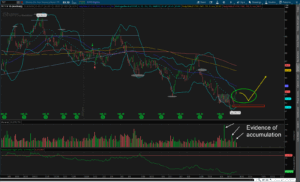
Any time you enter into a contrarian trade, you had better know who’s in the trade with you. You don’t want to be in a trade with guys that are worse traders than you. Believe me, it’s not comforting to know you’re the smartest guy and biggest position in a trade. You always want someone that’s a better trader than you with more money than you in the same trade. That means you’re with the smart money, not against it. At the moment, if you’re getting long US bonds, the biggest guy in the trade appears to be Scott Bessent.
For the first time in my life, we’ve got a guy in charge of the country’s finances who is not a banker, politician, or an academic, but a trader. He’s entering into one of the most consequential trades of his career. He has almost the entire world against him, but he says he has asymmetric information. There’s a chance he’s bluffing, but if he’s serious, he’s telling you that you shouldn’t be shorting bonds, and maybe you should think about getting long to go along for the trade with him. His last trade began the merging of Japan’s productive capacity assets onto the US balance sheet and put a ceiling in the USD/JPY. Maybe he’s about to put up another win in getting bond rates down.
I’m not sure if he’ll be successful in this trade, but I know I’ve got a low risk if I follow him into the trade. To manage my risk I’ve got a nice logical stop in TLT, I’m keeping an eye on the “Bat signal,” and I’m watching crude to judge how well Bessent is managing this trade. As long as crude stays well behaved under $85, the odds are in favor of a lower rate on the 10yr, which should make the duration risk inherent in the TLT pay off for anyone in the trade alongside the biggest shop in the country putting it on right now: the US Treasury.
These policy makers gambled with our future taking on all this debt.
Why not try to make some money off of it for ourselves?
_________________________________________
By: Patrick G. Full-time independent trader in Atlanta, GA.
Patrick G is a full-time trader. Worked for a decade in a money management firm as a trader for high net-worth individuals.
He invested his and his family’s net worth into gold and mining stocks before the Covid money printing. Gold and commodity runs of the past 3 years allowed Patrick to trade full-time due to his gains.
Past performance does not guarantee future results. Trading involves significant risk of loss, and individual results vary. Positions mentioned are the author’s own, disclosed for transparency — not individual investment advice.

FREE Training
3 Ways to Find Big Wins Starting Now