
Finding A Home In The Range
Looks like the consummate professionals on Wall St. have pulled off yet another masterpiece. They were able to cobble together the bullish conditions necessary for the upcoming Anthropic IPO. Back in July, I suggested that the pros on the Street would stop at nothing to get a series of successful IPOs out the door. It appears as though they will overcome all the odds against them and foment demand for another block buster stock offering.
The successful IPO of one of the big, household name AI companies was always the key ending to this AI story. Wall Street must show that it can create a successful narrative that sells financial assets. Even after this credit cycle finally ends, the business owners of the world will remember that Wall St. banks can still sell merchandise no matter how dire the conditions.
The financial conditions are dire under the surface regardless of what the index levels say. Capital is getting scarce, and the most marginal users of that capital are getting priced out. Some of the business models that depended on 3% rates to operate will be gone within the next year. Other than the biggest player in the space, Ares Capital, all the private credit names are down for the count. The chart of Blue Owl, OBDC, is representative of most of the names in the space.
OBDC:
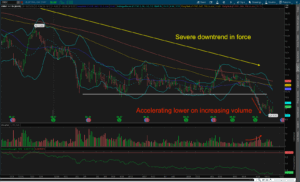
These marginal users of capital, the junk bond spreads, and consumer sentiment all tell the truth better than a stock price index like the SPX. The truth is that this business cycle is ending, and we’re already in the contraction phase. But just because the signs are now obvious that the economy is contracting due to higher costs of credit, it doesn’t mean the SPX has to play along and go down.
Because it’s imperative for Wall St to get an AI IPO out the door, they will move mountains to create the conditions required for a successful IPO. The first condition is that stock prices don’t decline. Stocks don’t have to go up necessarily, but they mustn’t break down. Below is a chart of the SPX with two particular days annotated. The first is August 4, the day when the number of traded call options on the SPX reached 4 million, an all time high. You can see that the index’s upward thrust was halted. The second day annotated is this week, Oct 19, when an all time high for put volume traded. It would be safe to assume that, just as record call trading halted upward acceleration, any downward acceleration in price has now been taken off the table with a massive open put position.
SPX Rangebound:
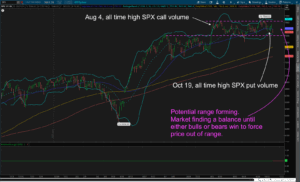
And just like that, an October crash is likely averted. With so much open interest in options with calls defining the top of the range and puts defining the bottom, the market is likely stuck in a range for some time. This is a market that is in balance between buyers and sellers. We’re going to need something unexpected to force the market into an imbalance where it can trend. Until that something occurs, I’m going to try to stay in the game by sizing down, buying weakness, and selling strength. That’s the opposite of what I’d look to do in a trending market where buying strength in breakout trades has a higher probability of working. The type of stocks I’ll look to buy will change as well as the market trades in a range waiting for one side to gain the upper hand.
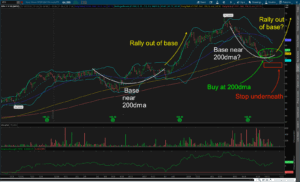
I’ll be looking to bid for stocks that fit with the contraction phase theme. That would be the defensive sectors like medicine stocks. TEVA, BIIB, AUPH, MRK, LLY and JNJ all have the right looking setups, and they all fit in with what the XPH Pharmaceutical ETF is doing. The XPH is holding at the 200 day moving average around $61 and has a low risk stop just below.
XPH Trade Plan:
This contraction phase should offer some very good opportunities to pick up long term assets that will pay us to own them. Those assets will have to offer better than the 5% we can get with Treasury Bills. That is a hard hurdle to jump over, so stock prices will have to come down significantly. Stocks are a speculative asset, and as such, we shouldn’t even think about owning them unless there is a sufficient margin of safety with a cheap price. Stocks this expensive are for renting only. The last time there was a glaring opportunity to buy long term assets was in 2023 when gold mining stocks were in the doldrums, and central banks were buying gold every month. The price had to rise over $2,000 at some point, but nobody wanted to wait in gold mining stocks at the time. They were a screaming buy. Before that, the opportunity to pick up long term assets was when crude oil crashed in March of 2020. Energy stocks were hated, ESG was all the rage, and because of that, big institutions were underweight energy stocks. The decline in March 2020 was the final leg down that offered patient buyers tremendous assets at discount values to park away in long term ownership. I had held EPD for a long time, but never got the chance to get a big position until March 2020. We will get the opportunity to pick up a left-for-dead sector once again, and indeed, it may already be here for one sector in particular.
The housing related stocks have been killed since the 2021 real estate boom ended. After this contraction phase runs its course, the early expansion phase should send housing stocks much higher. I’m looking at names that are tangentially related to housing like WY, WHR, SHW, FND, SWK, ETD, and MHK. These stocks are getting cheap, and a couple are already priced for a severe depression. They’re not out of the woods yet, as we haven’t gotten through the worst of the contraction phase. But I’m watching them for signs of a bottom as the housing market eventually heals. Young people in this country need more affordable housing, and there are only two ways to get that: build more houses or get more supply of existing houses on the market to lower prices. We may be getting close to the point where home sellers are giving up hope of ever attaining the 2022 price highs. The baby boomer generation will have to sell their second homes in the very near future as the youngest of them is getting to the point of decreased mobility. One house is enough to keep up with. An entire generation’s second home or vacation home will be be coming on the market within the next several years. All that supply is sure to lower prices to the point where the younger generation can buy and fill their home with furniture, appliances, flooring, new room color, and the tools to put it all together.
Even if more supply slowly leaks out into the housing market from aging baby boomers, the housing supply in this country is still under-built in the major metro areas where people work. In order to bring the supply of houses back up to historical levels, about 3.5M houses need to be built right now. There is years of housing demand ahead of us. The supply of new construction never kept pace with the population after the 2008 housing crash. In addition to the under-built supply of houses in the US, the current stock of owner occupied houses is aging. The median age of homes is 42 years old. I live in one of them, and believe me, the need for repair and renovation is only growing. The latent demand for housing related goods is like a dam about to burst. The only thing holding it back is a lack of income, but that could be changed in an instant with a pen stroke. The thing we are waiting on is healthcare legislation.
In this country today, our health insurance is the most expensive line item on our annual income statement. The unsubsidized cost of health insurance is greater than a mortgage for a starter home. The cost of even a high deductible health insurance plan with no subsidy is about $30,000 annually for a family. A mortgage, property taxes, and insurance bill is about $24,000 annually. The only way the average middle class citizen can afford health insurance in this country is with a subsidy either from their employer or the federal government. This is, of course, by design because we don’t actually have an “insurance” program for healthcare like you would think of car or home insurance. What we actually have is an incredibly complex payment scheme that places the cost of the entire medical system on the citizens whether or not they use the healthcare system. I see signs that the political decision makers are preparing for a change to this system that will free up tons of cash for the working class.
My wife works in the medical field, and she’s noticed a trend in the past two years. More patients are getting their health insurance from a relatively new insurer, Oscar. It turns out that Jared Kushner is one of the backers of the new insurer. Oscar is cheaper than the traditional health insurers on the state exchanges. With someone so close to the administration entering into an industry that even Jamie Dimon, Warren Buffett, and Jeff Bezos said was too difficult to work out, there has to be an understanding in the policy making circles that we can’t move into a growth phase as a country with the current healthcare payment system. One prominent insider, Kushner, has already planted a flag in the healthcare space and is ready for whenever the necessary change eventually comes.
Baby boomers letting go of second homes, new construction, and more disposable income in the hands of workers are conditions that are currently lying dormant, storing up potential energy, and waiting to be unbridled into the American economy. The only problem is that the timing isn’t yet right. We need to see the end of this contraction phase which will clear the malinvestment. Then, and only then, can we as a society, make the necessary changes to get back to growth. The initial recovery phase of the business cycle is just over the horizon. It’s taking a long time to get into view, but it will arrive quicker than we think. We just need to remain vigilant so as to take advantage of it when it comes.
Until then, this market seems content to stay in balance, comfortable in its home in the rage, and my trade strategy is to stick to stocks in contraction phase themes. I’ll buy weakness and sell strength in those names, and I’ll do the work to know what I want to own when the initial recovery comes into view. Cash is paying me to wait until the initial recovery phase. With 4% rates on short term paper, my cash is “working.” As long as it’s doing its job, I see no reason to assign it another task by placing it into a risky position. At some point soon, stocks will be in a position to work harder than cash, and only then will I “fire” my cash and “hire” stocks.
_________________________________________
By: Patrick G. Full-time independent trader in Atlanta, GA.
Patrick G is a full-time trader. Worked for a decade in a money management firm as a trader for high net-worth individuals.
He invested his and his family’s net worth into gold and mining stocks before the Covid money printing. Gold and commodity runs of the past 3 years allowed Patrick to trade full-time due to his gains.
Past performance does not guarantee future results. Trading involves significant risk of loss, and individual results vary. Positions mentioned are the author’s own, disclosed for transparency — not individual investment advice.

5 Days Free in a $7,000 Trading Room
Trade alongside David Prince live, Oct 26–30