
EVENT: 3 Strategies Working Right Now
David Prince shows you EXACTLY how to find big wins:
*By opting in, you consent to receive content and promotional emails from T3 Live.


Volatility is finally picking up! The VIX hit 3-month highs on Wednesday, and we’ve had 4 down days in the last 6. And traders are finally starting to believe we’re on the verge of seeing the first real shakeup since the 2016 Presidential election. So let’s take a fresh look at our sentiment indicators to see how traders are feeling after the shakeup. (click here for a primer on the sentiment indicators below) 1) VIX Spread – Bullish As noted above, the VIX hit a 3-month high on Thursday. It’s since come back down towards 11 on Friday. This gives us a 3-month spread of about +3.60, which means traders are moderately bullish. As you can see in the chart below, the VIX may be breaking out above its depressed 50 day moving average the way it did in August: (click here for a primer on the VIX spread) 2) CNN Fear & Greed Index – Neutral The Fear & Greed Index is at 50. This index operates on a 0-100 scale, so a reading of 50 is perfectly neutral. Before Thursday’s big reversal, it was actually at 35. On October 6, it hit multi-year highs at 95, so it’s obviously come back down to earth. Funny — a lot of folks thought that 95 reading meant we were peaking. But markets kept pushing higher, showing how difficult it is to time market moves from sentiment indicators. 3) AAII Sentiment – Bearish. The latest AAII Sentiment Survey shows that 29.3% of individual investors are bullish. This is a major collapse from last week’s 45.1% level, which itself was the highest since since January 5, 2017. The long-term average is 38.5%. 4) CBOE Equity Put-Call – Neutral The CBOE Equity-Put Call ratio was at 0.64 on Thursday, slightly below the 0.655 long-term average. The 10-day moving average is 0.652, which is right in-line with the long-term average. So it doesn’t get more neutral than this. Conclusion Out of 4 sentiment indicators, we have: 1 bullish (down from 3 last week) 2 neutral (up from 1 last week) 1 bearish (up from 0 last week) The permabears are still saying that everone’s all-in bullish and 100% complacent… but the numbers tell another story. If you want to see full-on bullish insanity, go back to October 6 when I declared the following: “Let’s not mince words: the bulls are clearly insane. They think they’re destined to ride into the sunset on a magic carpet made of cold hard cash.” Of course, I hedged myself by adding that “the bulls may be insane… but they may also be right.” And the bulls were right, with the major indices continuing to march higher. Trader aren’t bearish. We all know that. But based on the numbers, it’s fair to call the crowd neutral. This is ultimately good for the bulls. The more doubt there is, the more potential upside firepower. In particular, if the Russell 2000 can stage a comeback, we could see a major spike in confidence… along with a major spike in price. Just remember, sentiment follows the action, which makes it awfully tricky to use to time trades. Plus, sentiment can stay at extreme levels for far longer than you think is reasonable. So always use this information as color — not as specific buy/sell signals.
Continue Reading -->
So at 10:45 a.m. yesterday, I got an email with the subject line “The Most Important Person of Our Generation.” It came from Neil Strauss, author of the infamous pick-up artist memoir The Game: Penetrating the Secret Society of Pickup Artists: I know what you’re about to ask… And I can neither confirm nor deny that I read The Game. So, to whom was Neil referring as “The Most Important Person of Our Generation.”? Tesla (TSLA) CEO Elon Musk, whom Neil just profiled for a Rolling Stone cover story: Rolling Stone covers focus on entertainers, followed by politicians and athletes. I looked at hundreds of Rolling Stone covers going back to 1990 and I found exactly one CEO cover story… and it was about an even bigger tech icon. It was the October 27, 2011 issue commemorating Apple (AAPL) founder Steve Jobs, who had died 3 weeks earlier: Even in the late 1990’s dot-com boom, there wasn’t a single tech-focused Rolling Stone cover story, let alone a CEO story. And of course, this has me thinking about the magazine cover indicator. The magazine cover indicator says that a dramatic magazine cover story (typically a major business magazine like Fortune or BusinessWeek) can be a contrary indicator. The most famous example is BusinessWeek’s The Death of Equities cover in August 1979, which preceded the biggest bull market known to man. Chart from FinancialSense.com So did Rolling Stone ‘jinx’ Tesla? And the wider world of technology of stocks? Let’s see. In Neil Strauss email, he said he “spent the last nine months in and out of his world, working on this profile…” 9 months back from November 15 is February 15. Let’s assume that Rolling Stone spent a month before slating Musk for a cover story. In January, Tesla traded between $210.96 and $258.46. It hit $389.61 in September before pulling back to $312.49 when the story hit. Here’s what the stock chart looks like: Since Tesla’s at a bit of a crossroads now, only time will tell if Rolling Stone put in the ‘jinx.’ Or maybe I should put it another way. Only time will tell if Elon Musk marked a top in his ego — and by extension his Tesla/Solar City/Space X juggernaut — by agreeing to a Rolling Stone cover in the first place. So we’ll see. But what about technology overall? We know it’s been ripping since the election. But here’s a 20-year monthly chart of the S&P Technology ETF (XLK): Let me be clear: the magazine cover indicator should not be mixed up with actual science or rational analysis. It’s mostly valuable to permabears desperate for attention on Twitter. But I can’t help but ask: wouldn’t it be funny if tech topped out just as Rolling Stone broke tradition to put Elon Musk on the cover?
Continue Reading -->
Wonder what traders are talking about today?We’re here with the top 10 stories we’re sharing with colleagues today, covering topics like:Where the GOP Tax Plan standsWhy Target is collapsing aheadHow Sami Abusaad Made $72,867.08 During Earnings SeasonAnd more!So check out these links right now and get up to speed:1) Here’s Where the GOP Tax Plan Stands Right Now (Bloomberg) House leaders cleared the way for a Thursday vote on their tax-overhaul bill as Senate tax writers released a late-night draft that would make many individual breaks temporary and repeal a key part of the Obamacare law.Read the Story ==>2) Target shares sink as promotions darken holiday outlook (Reuters) Target Corp’s profit forecast for the key holiday quarter fell short of analyst expectations, sending its shares down nearly 10 percent, as the retailer continues to cut prices and invest in its delivery options to attract more customers.Read the Story ==>3) Sami Abusaad: How I Made $72,867.08 During Earnings Season (T3 Live) Sami made a profit of $5,449.09 in MHLD last week — a nice paycheck for 30 minutes of work. But this was just one of Sami’s great trades this earnings season. Watch the video and get a look at Sami’s actual account statements so you can see his $72,867.08 in total gains from this earnings season.Continued Reading ==>4) China is about to take the entire global economy for a wild ride (Business Insider) For now, Wall Street is wailing about a lack of volatility in global markets. Give it a few weeks, and that will all change. China is about to take us all for a wild ride. We’ve taken this ride at the end of every year since 2014, and all of the elements for a repeat are coming together.Continued Reading ==>5) Forex Outlook | EURUSD Breaks Resistance (T3 Live) In this special video, T3 Forex Strategist Kurt Capra take a live look at the EURUSD after it broke through resistance and triggered a pattern that could last into the end of the year.Continued Reading ==>6) A Record Number Of Investors Are Exposed To “Higher Than Normal Risk” (ValueWalk)With the stock market coming into November with another strong gain for the S&P 500 – the market was up for the statistically improbable 12th month in a row in October – investors are becoming aware of the increased risk exposure.Continue Reading ==>7) Snapchat’s New Test: Grow Like Facebook, Without the Baggage (T3 Live) In today’s social media industry, you essentially have two options: Die young, or live long enough to turn into Facebook. Snap, the parent company of Snapchat, appears to be headed down the latter path.Continue Reading ==>8) 7 Things to Know Before You Place Your First Options Trade (T3 Live) Today, we’re going to close out our Introduction to Options series with 7 key things you need to know before you place your first options trade.Continue Reading ==>9) Wall Street’s new bitcoin play: Square rises after saying it’s testing support of the cryptocurrency (CNBC) Traders have another potential stock play on bitcoin: Square. Jack Dorsey’s company is testing support for bitcoin through its Cash payments app.Continue Reading ==> 10) How to Become a Millionaire in 3 Years (Daniel Ally/YouTube) Learn how entrepreneur Daniel Ally became a millionaire at the age of 24. Watch this video and get Daniel’s 3 key principles for success:
Continue Reading -->
Welcome back to our Introduction to Options series! By now we’ve covered: 1) The ABC’s of Puts and Calls 2) How Implied Volatility Works 3) Theta: The Options Trader’s Kryponite 4) 3 Simple Options Strategies Beginners Should Know Today, we’re going to close out our series with 7 key things you need to know before you place your first options trade. These simple tips will help avoid common pitfalls that can destroy your profitability, so we hope you enjoy it! 1) Start with 1 Contract Yes, you want to swing for the fences and make a big fat pile of cold hard cash with your first options trade. But winning traders know that we’re not in a spring. We’re in a marathon. We recommend that you start slowly. So if you want to buy call options, just start with 1 contract, and carefully track your trade’s progress. Likewise, if you’re interested in multi-leg strategies like bull/bear call spreads or iron condors, just use one contract for each leg of your trades. A big part of your options trading education will come from actual trading — so make that education as inexpensive as possible! It’s very easy to make mistakes with options trading, particularly when it comes to order entry, and it’s best to start with small dollar amounts and work your way up. 2) Be Careful Getting in the Pool Naked Think twice before putting on naked short options positions. A naked short position is one in which you are short call or put options without an offsetting trade that limits your risk. The risk is astronomical and if the underlying stock makes a big move against you, your account will be damaged. So before putting on trades, consider the risk-reward, and makes sure the odds are in your favor. Shorting options can be very lucrative — especially in a volatile market when premiums are high — but you must be very careful. We recommend getting the guidance of a more experienced options trader before considering such a trade. Shorting options is especially risky ahead of earnings and other events. Case in point: take a look at this chart of online retail giant Amazon.com (AMZN). As you can see, it gapped up on 10/27/2017, the day after it reported a stellar third-quarter earnings report: Let’s say that when Amazon was trading around $980, you thought there was no way it could get above $1000. Ahead of earnings, you could have shorted the December $1,000 calls for around $28. So for each call you shorted, you would receive a credit of $2,800. Let’s look at what happened to this option’s price after earnings. The December $1,000 call closed at $25.15 on October 26 before the earnings report hit. And after Amazon beat expectations and skyrocketed, the option opened at $70.80. It then went over $100. It’s now trading at $131. Let’s assume you covered at $100 on the dot to keep things simple. This means you: Went short at $28 ($2,700 per contract) Covered the short at $100 ($10,000 per contract) That’s a net loss of $71, or $7,200 PER CONTRACT. A 3-contract trade would have put you out $21,600! So please, know what you are getting into when shorting options. And watch the calendar so you are aware of any stock-moving events. 3) Don’t Go Overboard with Out-of-the-Money Options In our last article on basic options strategies, we showed you this table explaining the differences between in-the-money options and out-of-the-money options: As you can see, out-of-the-money options have a higher chance of expiring worthless. But many new options traders love them because they have a lower up front cost. Beginners especially love far-out-of-the money options because they look so darn cheap. But there’s a reason they look so cheap… it’s because they’re lottery tickets. They don’t cost much, and there’s a low chance they’ll actually pay off. That’s not to say they’re inherently bad. Just be aware that with out-of-the-money options, especially those that are far-out-of-the-money, you’re rolling the dice. Plus, be aware that far out-of-the-money options can be very illiquid. It’s not unusual to get in a position (often at a bad price, because market makers often jack up the prices on out-of-the-money options), and be unable to get out because no one is interested in buying your particular options. It’s just like the roach motel: you check in but you don’t check out! 4) Be Careful with Your Entry Prices Like stocks, options have a bid and ask price. (the ‘ask’ is also called the ‘offer’) The bid is the price buyers are willing to pay. The ask is the price at which sellers are willing to sell. But if you are always buying at the ask and selling at the ask, you’re getting ripped off. Let’s look at red hot streaming media play Roku (ROKU). With the stock trading at $45.27, here are the prices of the December $44, $45, $46, and $47 calls. This is an extreme example so you can see just how easily you can get fooled by looking at the bid and ask. Let’s say we’re looking at the $44 calls. The market maker would LOVE to sell us those options at $6.80 (the ask). That’s like walking into a used car dealership and taking the first price the salesman offers up. Odds are we can actually get filled somewhere near the middle of the bid and ask. The midpoint of the $5.50 bid and $6.80 offer is $6.15. So if we bid $6.20-$6.30 or so, odds are we’d get filled. Heck, we may even get filled at the exact midpoint of $6.15. But let’s say we got filled at $6.30. That’s a savings of $0.50, or $50 per contract. On a 10-contract trade, that’s a difference of $500. This is an extreme example. Roku is a fast-moving new IPO. Options on tThese types of stocks typically have extremely wide-bid ask spreads. But we want you to understand the importance of not blindly placing orders at the bid
Continue Reading -->
Welcome back to our Introduction to Options series! By now we’ve covered: 1) The ABC’s of Puts and Calls 2) How Implied Volatility Works 3) Theta: The Options Trader’s Kryponite Now we’re going to dig into 3 basic options trading strategies that are perfect for beginners. We’re going to teach you 3 options trading strategies that allow you to speculate on 3 scenarios: A stock making a big move higher A stock making a small move higher A stock doing nothing But before you start, there’s one thing you must understand about options trading: for every stock scenario you can think of, there are 1 million ways to play it with options. Let’s say Amazon.com (AMZN) is trading at $1,000, and you think it’s going to $1,500 in one year. Here are 7 ways a trader could use options to speculate that move: Buy call options Buy bull call spreads Sell put options Sell bull put spreads Buy a butterfly spread Buy a risk reversal Buy a call back spread Every strategy has pros and cons, and no single one is best. Please note that all examples in this article are pure hypotheticals — they are not endorsements of these particular trades. Strategy #1: Buying Call Options to Speculate on a Big Rally At the time we’re writing this, Gilead (GILD) was trading at $75.00 Let’s assume we are very bullish on the stock, and believe it can hit $100 in the next 12 months. The simplest way to speculate on such a movement is to buy call options. You’re probably asking yourself yeah, but which ones? We can choose between in-the-money, at-the-money, and out-of-the-money calls. As a quick reminder, for call options, in-the-money options have strike prices below the current stock price. At-the-money options have strike prices that are about the same as the current stock price. And out-of-the-money options have strike prices above the current strike price. You can see relationship here: So which one is best? In the money, at the money, or out of the money calls? The answer is… none of them and all of them. Let’s look at the differences. Here’s a table detailing the major differences between in and out-of-the-money options: Let’s look at some numbers to illustrate these differences. Here are the prices of GILD call options with 24 days to expiration, with the stock trading at $75: The at-the-money $75 call is priced at $1.98. The in-the-money $70 call is $5.40. And the out-of-the-money $80 call is just $0.65. And as you can see, the in-the-money options cost more up front, and the out-of-the-money options cost less. This is because the in-the-money options have intrinsic value, and have a higher chance of being in the money at expiration. And that’s the tradeoff: you pay more for in-the-money options, but the option has a higher likelihood of being in the money. On the flipside, out-of-the-money options cost less up front, but give you a lower likelihood of success. And because they cost less, out-of-the-money options can give you a bigger percentage gain if the underlying stock makes a big move in your favor. Let’s take a look at possible payoffs of each option at expiration under a variety of price scenarios. On this table, here is what each option would be worth at expiration under different price scenarios: Let’s assume GILD goes flat, and is at $75 at expiration. Focus on the middle column of that table. As you can see, if GILD went to $75, the $65 calls would still be worth $10 ($75 – $65) — just a little less than the $10.77 cost. And the $75, $80, and $85 calls would be worth zero. Now let’s take a look at the P&L of these options: As you can see on the right column on the table, if GILD is at $85 at expiration, the $65, $70, $75, and $80 calls would have value: The $85 calls would expire out of the money and be worthless, giving a 100% loss of the $0.19 premium paid. The $65 calls would give you the largest dollar profit at $9.23. Here’s a third table showing the P&L on a on a percentage basis: As you can see, the $80 calls would give you the highest profit at $669% They cost just $0.65, and rose to $4.35. But remember the trade offs we discussed earlier: Out-of-the-money options cost less up front, but give you a lower chance of success. And because they cost less, out-of-the-money options can give you a bigger percentage gain if the underlying stock moves in your favor. We can also choose between shorter-dated and longer-dated options. If you recall from our article on time’s role in options pricing, longer-dated options cost more than shorter-dated options. As you can see on this chart, the more days there are to expiration, the higher the price of the option is: The call option expiring in 3 days costs just $0.88. And the one with 31 days to expiration costs $2.77. Through this options series, we’ve compared options to car insurance. A call option is an insurance contract that pays off when the stock rises. Ask yourself this: would it cost more to insure your car for 1 year? Or 2 years? Obviously, you pay more for 2 years of insurance coverage than 1. Why? Because over a 2-year period, there’s a much greater chance of something happening than over 1 year. So how should you choose which call options to trade? There is no simple answer. We recommend figuring out where you think the underlying stock could go within a certain time frame. Then, decide what’s more important: paying more money up front with a higher chance of success (in or at-the-money options), or paying less up front with a lower chance of success (out of the money options). Strategy #2: Buying a Bull Call Spread to Speculate on a Small Rally At the time of this writing on November 9, 2017, shares of
Continue Reading -->
In this special video, Sami Abuaad of the Strategic Swing Trader Program takes you through an Earnings Play in insurance company Maiden Holdings (MHLD). This is a great example of just how lucrative trading during earnings season can be. Just before the market close on Wednesday, MHLD showed an “awesome” Weekly Sell setup, and Sami went short at $8.40 into earnings. The stock gapped down and Sami got out at $6.525 for a fast gain of 22%. In real dollar terms, Sami made a profit of $5,449.09 — a nice paycheck for 30 minutes of work. But this was just one of Sami’s great trades this earnings season. Watch the video and get a look at Sami’s actual account statements so you can see his $72,867.08 in total gains from this earnings season. (click here to join the Strategic Swing Trader Program and join Sami in these incredible trades!) Watch this video and see: Sami’s $72,867.08 in total gains realized this earning season, which you can see in his actual online account statements Why the MHLD daily chart showed a potential gap down after earnings Sami’s actual statements from his trading account this week How Sami also made highly profitable trades in names like TripAdvisor (TRIP) Mallinckrodt (MNK), and Textainer Group (TGH) Interesting in getting Sami’s next big swing trade? Click here to learn about Sami’s Nightly Game Plan P.S. Earnings Season is still going strong. Be sure to check out this FREE Earnings Season resource: The Ultimate Guide to Trading Earnings Season
Continue Reading -->
On Thursday, we had our first hint of real volatility since October 25. The the SPX dropped -1.1% to an intraday low of 2566.33 before a bounce up to close at 2584.62. The VIX also rose over 20% to 12.19 before faltering. This came on the heels of some minor equity market deterioration as small caps and banks retreated. So let’s take a fresh look at our sentiment indicators to see how traders are feeling after the shakeup. (click here for a primer on the sentiment indicators below) 1) VIX Spread – Bullish As noted above, the VIX spiked over 20% on Thursday before coming back down, and it was at 11 Friday morning. This gives us a 3-month spread of about +3.50, which means traders are moderately. (click here for a primer on the VIX spread) 2) CNN Fear & Greed Index – Bullish The Fear & Greed Index is at 54. This index operates on a 0-100 scale, so a reading of 54 is almost perfectly neutral. 5 weeks ago, the index hit multi-year highs at 95, but it’s come back down to earth. Funny — a lot of folks thought that 95 reading meant we were peaking. But markets kept pushing higher, showing how difficult it is to time market moves from sentiment indicators. 3) AAII Sentiment – Bullish The latest AAII Sentiment Survey shows that 45.1% of individual investors are bullish, flat from last week.. This is above the long-term average of 38.5%, so it shows bullishness. In fact, this 45.1% level is the highest reading since January 5, 2017. AAII sentiment has been depressed throughout 2017 despite the market hitting a nonstop streak of all-time highs. This seems like a notable change. 4) CBOE Equity Put-Call – Bullish The CBOE Equity-Put Call ratio was at 0.64 on Thursday, slightly below the 0.655 long-term average. The 10-day moving average is 0.631, which is slightly above the long-term average, indicating higher-than-normal demand for put options. I would call this very slightly bullish. So it looks like the little Thursday shakeup has had little to no impact on traders’ general bullishness Conclusion Out of 4 sentiment indicators, we have: 3 bullish (down from 4 last week) 1 neutral (up from 0 last week) 0 bearish (flat last week) Make no mistake, the crowd is bullish. But it’s less bullish than last week, and certainly less bullish than 5 weeks ago, when the CNN Fear & Greed Index was hitting multiyear highs. Incidentally, the VIX was setting new all-time records for weakness. So while the permabears are still saying the crowd is complacent, I’m not convinced. On October 6, I said this: Let’s not mince words: the bulls are clearly insane. They think they’re destined to ride into the sunset on a magic carpet made of cold hard cash. Turns out those bull were right, though they’ve backed down from their optimism just a bit. Now we’re about to see if sentiment has pulled back enough to set the stage for another rally. I’d keep a close eye on the Russell 2000. It it rockets back up, the bulls are bound to go gaga once again. For now, it looks like a failed bull flag pattern is on the table: In an ideal world, the bulls will at least push it back into that upper range. Then again, the bulls haven’t needed an ideal world to find reasons to keep on buying. We’ll see if that changes.
Continue Reading -->
Wonder what traders are talking about today?We’re here with the top 10 stories we’re sharing with colleagues today, covering topics like:The stock market in the first year since President Trump’s 2016 election victoryThe post-earnings collapse in fallen tech star Snap (SNAP)Whether the lucrative, exciting world of prop trading is right for youAnd more!So check out these links right now and get up to speed:1) A year in: U.S. stock market under Trump’s shadow (Reuters) One year ago, when it became clear that Republican Donald Trump had pulled a historic upset to defeat Democrat Hillary Clinton to the U.S. presidency, futures in the Dow Jones Industrial Average tumbled nearly 900 points.Read the Story ==>2) Snap plunges after huge revenue miss (CNBC) Snap dropped 16 percent after it missed on revenue during its third quarter earnings Tuesday. Snap also wrote down $39.9 million as a result of losses from unsold SpectaclesRead the Story ==>3) The Ultimate Guide to Prop vs. Retail Trading (T3 Live) If you want to be an active trader in individual stocks, you really only have two general paths: Become a professional trader (prop trader) or trade in a retail account. Let’s look at the advantages and disadvantages of both so you can figure out the right path for you.Continued Reading ==>4) America’s ‘Retail Apocalypse’ Is Really Just Beginning (Bloomberg) The so-called retail apocalypse has become so ingrained in the U.S. that it now has the distinction of its own Wikipedia entry. The industry’s response to that kind of doomsday description has included blaming the media for hyping the troubles of a few well-known chains as proof of a systemic meltdown.Continued Reading ==>5) How Implied Volatility Works (T3 Live) We’re going to dig into the single most important options pricing concept: implied volatility. If you don’t understand implied volatility, you don’t understand options. Period!Continued Reading ==>6) Ralph Northam wins Virginia’s governor race (The Economist)Observers braced for a late night. Virginia’s polls close at 7pm, and precincts in the diverse, densely populated suburbs of Washington, DC usually take a long time to come in.Continue Reading ==>7) Trading Scans: The Foundation for Winning Trades (T3 Live) Take a look at our latest trading scans, which can help you find potential capitulations and explosions out of consolidations. Get our exact metrics and replicate them yourself.Continue Reading ==>8) Broadcom takes page from Drexel playbook with Qualcomm offer (Pittsburgh Post-Gazette) Broadcom is using a tactic popularized by corporate raiders in the 1980s to convince Qualcomm and its shareholders that it has the means to complete the biggest tech deal ever.Continue Reading ==>9) Deloitte Report: Over 26,000 Blockchain Projects Began in 2016 (CoinDesk) More than 26,000 new projects related to blockchain were created on code repository GitHub last year, according to data collected by Deloitte. For its new report – titled “Evolution of Blockchain Technology: Insights from the GitHub Platform” and published today – the professional services firm drew information from the development platform, which plays home to the code for over 86,000 blockchain initiatives, including major projects like bitcoin.Continue Reading ==> 10) Denzel Washington on the Power of Falling Forward (NY Times) In 2011, Academy Award-winning actor Denzel Washington explained why you need to embrace failure to be ready for success.
Continue Reading -->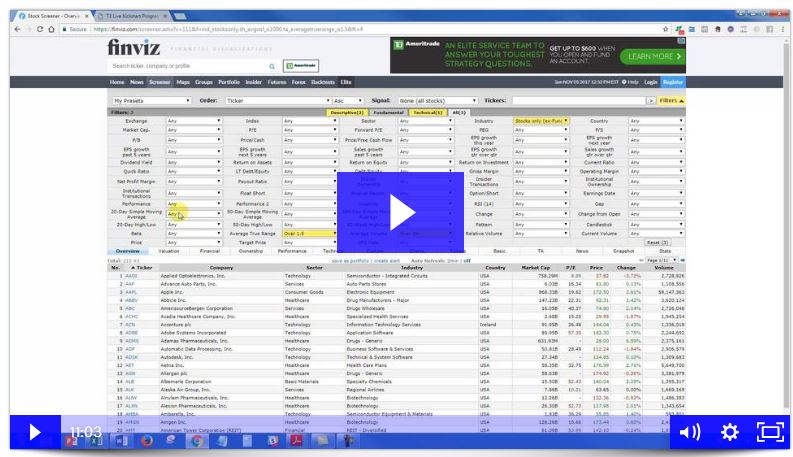
Additional scans below the video.A quick note about the scans. Have some fun combining them to find even greater opportunities such as a bullish momentum trade combined with double normal volume = a potential capitulation signaling the end of recent momentum (and a place to book profits) or an explosion out of a consolidation (that leads to an all-new trend!) Scan Criteria: Bullish Trends: Performance “month Up” + 20 day simple moving average “price above SMA 20” + price “over $20” + 50 day simple moving average “price above SMA 50” + 200 day simple moving average “price above SMA 200” + Industry “stocks only” + Average true range “over 1.5″ + Average volume ” Over 2 million” Bearish Stocks: Performance “month down” + 20 day simple moving average “price below SMA 20” + price “over $20” + 50 day simple moving average “price below SMA 50” + 200 day simple moving average “price below SMA 200” + Industry “stocks only” + Average true range “over 1.5″ + Average volume ” Over 2 million” Double Normal Volume: Price “over $10” + Average True Range “over 1.5″ + Average volume ” over 2M” + Relative volume “over 2” + Industry “stocks” Short-term bullish momentum: Performance ” Month up” + Price “over $10″ + Performance 2 ” Week up” + Average true range “over 1.5” + Average volume “Over 2M” + Industry “stocks” + Change from open ” up 2%” Short-term bearish momentum: Performance ” Month down” + Price “over $10″ + Performance 2 ” Week down” + Average true range “over 1.5” + Average volume “Over 2M” + Industry “stocks” + Change from open ” down 2%”
Continue Reading -->
Traders had two questions heading into Apple’s (AAPL) Q4 earnings report yesterday after the close: 1) Can the company produce enough iPhone X units? 2) Can the company sell enough iPhone 8 units? Apple answered both questions with an emphatic yes, proving once again that the Apple supply chain rumor mill can’t be trusted. The media does a great job of sniffing out Apple product announcements, but they’re awful at figuring out just how much product the company is selling. We’ve been hearing a lot of rumors about weak iPhone demand, and we know now that they had zero basis in reality… not that the bears would admit that. Apple reported EPS of $2.07, smashing the $1.87 consensus. Revenue was $52.6 billion, easily beating Wall Street’s $50.7 billion forecast. iPhone units were also above expectations, as was Q1 revenue guidance. Apple shares hit an all-time high at $174.26 this morning before some minor profit-taking hit. We still have to see what happens with Nvidia’s (NVDA) earnings report on Thursday, but make no mistake: tech earnings season has been nothing short of fantastic. The October nonfarm payrolls report was released on Friday, revealing that the economy added 261,000 jobs in October, missing the 310,000 Wall Street consensus. The unemployment rate was 4.1%, besting the 4.2% expected. However, the big story was Average Hourly earnings, which were unchanged. Economists expected growth of 0.2%. The numbers point to a strong labor market that isn’t generating much wage inflation. Workers are in demand, but pay just isn’t going up. The lack of wage growth means the Fed could continue to undershoot its inflation goals. The US dollar and Treasury yields fell after the numbers hit, but reversed afterwards. Gold shot up but dipped back into the red. This morning, T3 Live Chief Strategic Officer Scott Redler said that “yesterday, SPX broke below 2567 momentarily, and we now have the 2566 low as our new point of reference. As long as that holds, not much changes. We didn’t come close to that 2566 low, implying that the bull move remains fully intact. The relentless bid that keeps stock pumped in the face of a chaotic news flow is proving endlessly frustrating to the bears. Every time there’s a sign of trouble — like the recent weakness in the Russell 2000 — it quickly gets reversed and we see new headlines celebrating all-time highs. Now it seems like the only element left is time. The market’s been zooming higher and higher ever since the Presidential election. The longer time goes on, the greater probability of an unexpected shock. But betting against the likelihood of a shock has been the best trade in the market. The VIX can barely stay above 10, there’s almost no intraday movement, let alone run-of-the-mill 5% to 10% drawdowns that used to be fairly common place. So unless we get some actual technical deterioration in the charts, the only thing the bears can hope for is a shock that comes out of nowhere and destroys faith in the system. Sooner or later, something bad will happen. It always does. But good luck predicting when…
Continue Reading -->